


The AI Trust Stack: Every AEO and GEO Signal That Matters in 2026
 Preferred source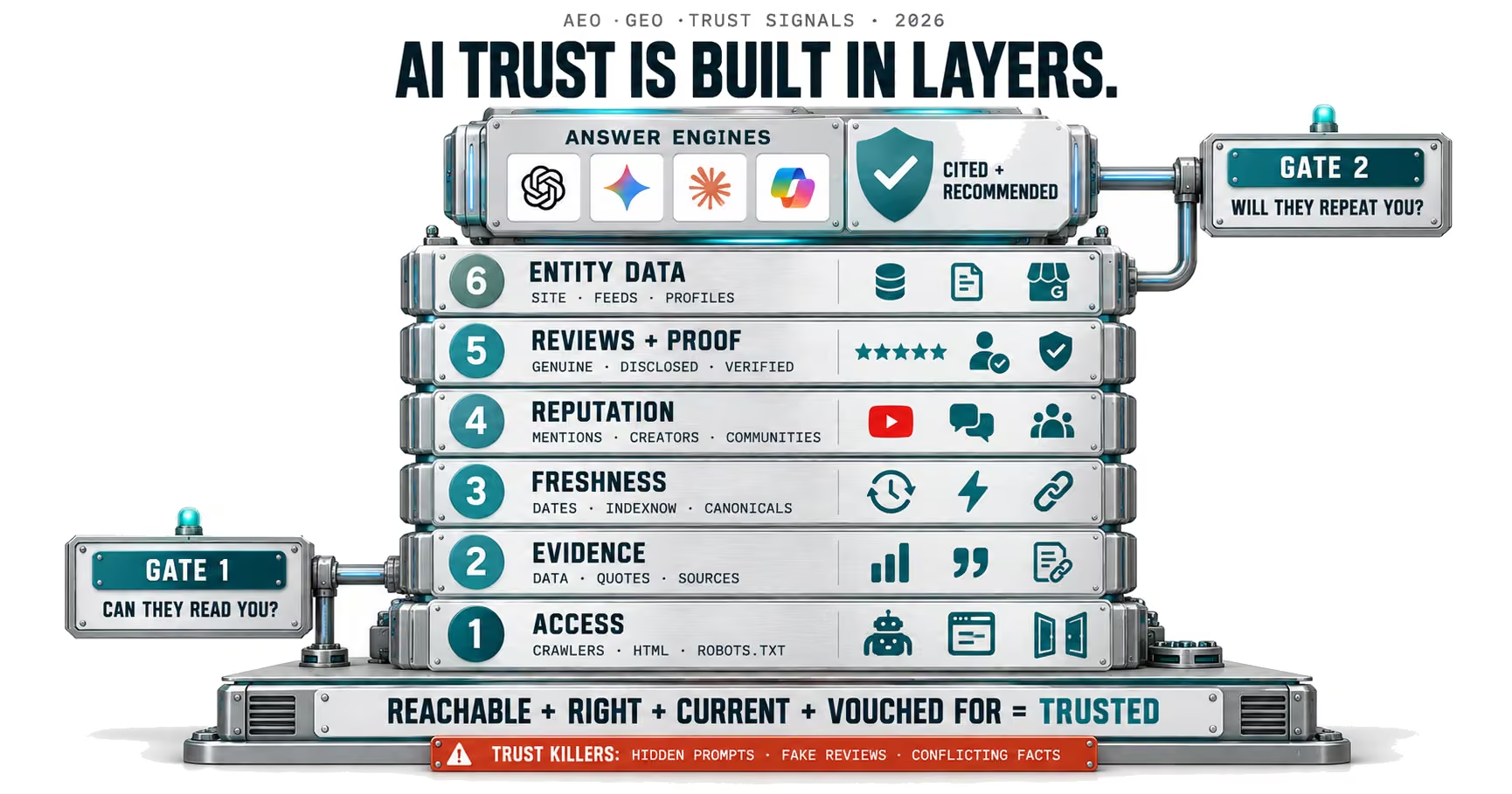
Trust gets checked twice now
Classic search asked one question: which pages deserve to rank? AI answer engines ask a second one before they say anything: which facts are safe to repeat to this person, in our own voice? That second check is where most brands quietly lose.
Microsoft described the shift plainly in a May 2026 post on the Bing index. Evidence "needs clear provenance and varying evidentiary weight," and when support is missing, stale or conflicting, the system can simply abstain.
In grounding, a stale fact produces a misleading response.
Google frames it differently but lands in the same place. Its 2026 guide to generative AI features, announced by John Mueller on the Search Central blog on May 15, says those features are rooted in core ranking and quality systems. As Search Engine Journal reported, Google's line is that optimizing for generative AI search is "still SEO." That is true, and it is also incomplete, because the answer layer adds tests a ranking never had to pass.
The audience is checking too. Pew found in its 2026 survey of 5,119 U.S. adults that six in ten read AI search summaries and about half use AI chatbots, up from a third in 2024. Yet the Reuters Institute Digital News Report 2026 found only 20% of people globally trust AI chatbot answers for news, against 37% for news overall. Trust in the answer is borrowed from the sources behind it: an Ipsos study for AOP, reported in Press Gazette, found trust in an AI answer rises above 90% when it cites a completely trusted source and falls to around 10% for a distrusted one.
What the platforms said about trust in 2026
This year, every major platform put something on the record. Here is the short list worth pinning to your wall.
| Platform | What it said | When |
|---|---|---|
| AI features rooted in core ranking and quality systems | May 2026 | |
| Spam policies apply to generative AI responses | May 2026 | |
| Microsoft Bing | Examples, data and cited sources build trust | Feb 2026 |
| Microsoft Bing | Facts need clear provenance; stale facts mislead | May 2026 |
| OpenAI | Ads do not influence ChatGPT answers | Feb 2026 |
| Anthropic | Blocking Claude-SearchBot may reduce visibility | Feb 2026 |
| UK CMA | Google must attribute publishers with clear links | June 2026 |
Sources, in order: Google's AI guide, Google's documentation changelog, Bing Webmaster Blog, Bing Search Blog, OpenAI, Anthropic's crawler docs via Search Engine Roundtable and the CMA.
Read together, these statements describe six layers. We call it the trust stack. Each layer has to hold for the next one to matter.
- Access
- Evidence
- Freshness
- Reputation
- Reviews and proof
- Entity and product data
Layer one: access, can machines actually read you?
Trust starts with being readable. Google's guide says its generative AI models "use publicly accessible, crawlable content," and a site must be included in Search generative AI features in Search Console to be eligible at all. That eligibility is now a switch: Google's new Search Console control, rolled out globally on August 31, 2026 according to Search Engine Land, lets owners opt out of AI Overviews, AI Mode and AI Overviews in Discover, and Google warns opted-out sites get no traffic or impressions from those features.
The other engines work the same way through their crawlers. Anthropic's documentation, quoted by Search Engine Roundtable in February 2026, says disabling Claude-SearchBot "may reduce your site's visibility and accuracy in user search results." Google's John Mueller summed up the minimum in June, per Search Engine Journal: "the most basic agentic optimization is in place, namely: don't block agents."
The stakes are rising because bots now outnumber people: Cloudflare's July 2026 bot report says more than 50% of internet traffic is now non-human, and training requests rose from 22% of crawler activity in spring 2025 to 52% in June 2026. Be careful with blanket bot blocking. Cloudflare's September 2026 data shows fewer than 1% of its sites block search bots, while 17% restrict training, and its new Disallow AI Training setting lets you stay indexed for search while refusing training. Cloudflare also began blocking mixed-use crawlers by default on pages with ads from September 15, 2026, for new customers and free customers who had not changed their settings. If you are on Cloudflare, check what your dashboard is doing on your behalf.
Then check whether the words are in the HTML. Most AI crawlers still do not run JavaScript. Helen Pollitt, writing in Search Engine Journal in January 2026, summarized earlier tests showing only Gemini, Applebot and Common Crawl rendered JavaScript, and advised: "check your static HTML." The cost of getting this wrong is measurable. Adobe data reported by TechCrunch found about 34% of retail product page content could not be properly accessed by AI, even as AI traffic to U.S. retailers grew 393% in Q1 2026.
Layer two: evidence, give machines something safe to repeat
Once you are readable, the question becomes whether your content contains facts worth citing. Google's guide leans on first-hand experience: "a first-hand review provides a unique perspective based on personal experience," and it calls for "non-commodity" content that adds something the rest of the web does not.
Microsoft is more prescriptive. In launching AI Performance in Bing Webmaster Tools in February 2026, Bing advised that "examples, data, and cited sources help build trust when content is reused in AI-generated answers," and that "clear headings, tables, and FAQ sections help surface key information."
Examples, data, and cited sources help build trust when content is reused in AI-generated answers.
The academic evidence agrees, with limits. A July 2026 critical survey of GEO research by Olivier Martinez found query relevance and position in the model's context are the two most robust factors, that extractable evidence such as statistics, definitions and quotations helps when it is genuine and relevant, and that keyword stuffing produces "null or negative" results. The survey also notes that the widely quoted "up to 40%" gain from the original GEO paper was measured inside a five-document simulator, not on the open web.
Structure helps retrieval too. AirOps analyzed 16,851 queries in ChatGPT, and Search Engine Land reported that pages whose headings closely matched the query were cited 41% of the time versus about 30% for weak matches, with 500 to 2,000 words performing best. AirOps sells AI content software, and it scraped the ChatGPT interface rather than the API, so treat the exact numbers as directional.
Layer three: freshness, stale facts lose trust
Freshness used to be a tiebreaker. In answer engines it is closer to a safety check, because repeating an outdated price, policy or spec is worse than saying nothing. Bing's May 2026 index post says stale content "can directly produce wrong answers," and lists abstention as a valid outcome when support is stale.
The citation data points to a sweet spot rather than a race to publish daily. The same AirOps study found ChatGPT cited content aged 30 to 89 days most often, with brand new pages doing worse. Update what changes, date it honestly, and tell the engines when it changes: Bing's guidance recommends IndexNow so AI systems reference the current version of a page.
Old versions can also compete with new ones. Cloudflare found OpenAI's crawler hit its deprecated documentation around 46,000 times in a single month, and in April 2026 it launched Redirects for AI Training, which turns existing canonical tags into 301 redirects for verified AI training crawlers. A twenty year old tag, the canonical, just became an AI freshness tool.
Layer four: reputation, what the web says when you are not in the room
This is the layer that separates brands AI recommends from brands it merely indexes. Ahrefs studied 75,000 brands across ChatGPT, AI Mode and AI Overviews, and The Next Web reported these Spearman correlations with AI brand visibility.
| Signal | Correlation |
|---|---|
| YouTube mentions | 0.737 |
| Branded web mentions | 0.66 to 0.71 |
| Domain rating | 0.266 to 0.326 |
| Site page count | 0.194 |
Ahrefs sells SEO software and notes that correlation is not causation. Still, the direction is hard to ignore: being talked about, especially on video, tracks AI visibility far more closely than raw link authority. Ranking alone no longer guarantees a seat either. Ahrefs data reported by Search Engine Journal found only 38% of AI Overview citations came from top-10 pages in March 2026, with YouTube alone accounting for 5.6% of all citations.
Where the conversation happens matters by platform. Peec AI analyzed 30 million cited sources, and Search Engine Land reported that Reddit, YouTube, LinkedIn, Wikipedia and Forbes led overall, with ChatGPT leaning on Wikipedia and Reddit and Google AI Mode leaning on Facebook and Yelp. For retail searches, Comscore data reported by Search Engine Land put YouTube at 23% of AI Overview citations, Amazon at 14% and Reddit at 12%.
Google is building this directly into the interface. In May 2026 it began adding previews of perspectives from forums, social media and other firsthand sources to AI responses, with creator names and community labels, TechCrunch reported. It also extended preferred sources to AI Mode and AI Overviews, where content from a site a user has chosen can carry a "preferred" badge. That makes audience loyalty a visible trust signal for the first time.
One warning from Google's own guide: seeking "inauthentic mentions" is on its list of things to ignore. Reputation has to be earned in public, by real people.
Layer five: reviews and proof, the fastest trust signal to fake and the most policed
Reviews are where AI trust meets consumer protection law, and 2026 tightened both sides. Google updated its review snippet guidelines on July 24, 2026, according to its documentation changelog, to address fake and undisclosed incentivized reviews. In May, the FTC and Illinois took action against Premium Home Service, alleging it created thousands of fake business listings and fabricated five-star reviews, including counts under the FTC's reviews and testimonials rule.
Review platforms are becoming direct inputs to AI answers. In July 2026, OpenAI and Yelp struck a deal that lets ChatGPT include Yelp reviews, ratings, photos and business details in local answers, Search Engine Land reported. But the classic software review sites are a smaller slice than many assume: GetIntel's August 2026 index of 9,978 answers, reported by The Next Web, found G2, Capterra and TrustRadius together made up just 5% of citations, behind TechRadar and Reddit. GetIntel describes its data as a single day from two engines with no error bars.
The lesson: collect genuine reviews on the platforms your buyers and the engines actually use, disclose any incentive clearly, and never manufacture them. A fake review is now a spam problem, a legal problem and an AI trust problem at once.
Layer six: entity and product data, tell machines exactly who you are
AI systems need unambiguous facts about your business and products, and in 2026 the platforms opened direct pipes for them. Google's guide says Merchant Center feeds and Google Business Profiles can help products and services show up in AI responses. Bing's guidance points local businesses to Bing Places for accurate address, hours and contact details.
For commerce, the pipes are now protocols. Google launched the Universal Commerce Protocol in January with dozens of new Merchant Center attributes for conversational shopping. OpenAI said in March that through its Agentic Commerce Protocol, merchants share product feeds and promotions so their catalogs are fully represented in ChatGPT. OpenAI also says ads do not influence the answers ChatGPT gives, which means feed quality, not ad spend, decides organic product visibility there.
Consistency is the trust signal inside the data. If your price, hours or specs disagree between your site, your feed and your Business Profile, you have handed the engine exactly the conflicting evidence Bing says can lead it to abstain. For more on why clean brand data matters, see our piece on how better brand data can fix AI search's trust problem.
Old tech versus new tech: what still earns trust in 2026
Not every trust signal is new. Some of the oldest web standards are doing more work than ever, and some of the newest are mostly noise. Here is the scorecard, based only on 2026 evidence.
| Technology | 2026 status | Evidence |
|---|---|---|
| Crawlable HTML | Essential | Google guide; JS rendering gaps |
| robots.txt | Essential, now three-way | Cloudflare search, agent, training split |
| Canonical tags | Newly powerful | Cloudflare AI training redirects |
| IndexNow | Useful for Bing and Copilot | Bing AI Performance guidance |
| Business Profile, Places | Useful | Google guide, Bing guidance |
| Schema markup | Hygiene, not a lever | Ahrefs test; FAQ rich result retired |
| llms.txt | Unproven | Google does not use it; 97% unread |
| Search Console AI control | New, essential | Google, June 2026 |
| Bing Citation Share | New, useful | Bing, June 2026 |
| WebMCP, agent auth | Early | Chrome preview; Google-Agent |
| Commerce protocols | New, high value | UCP, ACP feeds |
| SynthID, C2PA | Media only | Google, May 2026 |
A few notes behind the table. Schema is not dead: Ahrefs found cited pages were roughly three times more likely to have JSON-LD, but adding it to 1,885 already-cited pages produced no major uplift, and a separate searchVIU test found five AI systems ignored JSON-LD when fetching pages live, Search Engine Journal reported. Google also retired the FAQ rich result on May 7, 2026, per its changelog. Keep structured data accurate for products, reviews and your organization, and stop expecting it to win citations on its own.
On llms.txt, Google's documentation says Google Search does not use it, and Mueller called its value "purely speculative for now". Ahrefs found 97% of llms.txt files got zero requests in May 2026, with coding agents rather than search bots driving most of the traffic that did arrive. Chrome's Lighthouse does now check for it in a new Agentic Browsing category, Search Engine Land reported, but that is about agent functionality, not trust or ranking.
The new layer is agents. Google introduced a Google-Agent user agent in March 2026 for agents that act on a user's request, and is experimenting with web-bot-auth to verify them. Chrome opened an early preview of WebMCP, "a standard way for exposing structured tools" so agents can act on your site reliably, and Mueller said he likes "the WebMCP approach, as well as the commerce integrations." These are early, but they point to where trust goes next: from "can I quote you" to "can I transact with you."
Provenance technology is advancing for media, not text. Google said in May 2026 that SynthID has marked over 100 billion images and videos and is expanding verification to Search and Chrome, alongside wider C2PA Content Credentials support. We found no 2026 evidence that provenance tags change how text pages are cited, but for brands publishing original photography and video, they are worth adopting.
Trust killers: what gets you excluded
The fastest way to lose AI trust is to try to fake it. Google clarified in May 2026 that its spam policies apply to generative AI responses, and its policies now name "attempting to manipulate generative AI responses in Google Search" as spam. Its guide adds that creating content for fan-out queries primarily to manipulate AI responses violates the scaled content abuse policy.
- Hidden instructions to AI. Microsoft found 50 prompt injection attempts from 31 companies hidden in "Summarize with AI" buttons that told assistants to remember a brand as a trusted source.
- Fake or undisclosed incentivized reviews. They now breach Google's review snippet guidelines and can trigger FTC action.
- Inauthentic mentions. Google lists chasing them as a myth to ignore, and manufactured buzz is the easiest pattern for platforms to discount.
- Scaled AI content. Mass-produced pages aimed at fan-out queries fall under scaled content abuse, however they were made.
- Contradictory facts. Conflicting prices, hours or specs across your site, feeds and profiles give engines a reason to abstain.
Regulators are raising the stakes on the platforms themselves. The UK CMA now requires Google to ensure publisher content is properly attributed, using clear links, in AI-generated results, which rewards being the clearly credited original source.
How to measure trust without fooling yourself
You cannot manage what you cannot see, and in 2026 you can finally see some of it. Google's generative AI performance reports show impressions in AI Overviews and AI Mode by page, country and device, though not clicks. Bing goes further: its AI Performance report shows total citations, cited pages and grounding queries, and in June 2026 it added Citation Share, "the percentage of citations attributed to your site out of all citations shown across all sites for that same grounding query."
For prompt tracking, remember that single answers are noise. SparkToro and Gumshoe ran 2,961 prompts 60 to 100 times each and found less than a 1% chance that ChatGPT, Claude or AI Overviews returned the same brand list twice. Gumshoe sells AI tracking tools, but the practical lesson holds: measure how often you appear across many runs, not where you appear in one. GetIntel also found ChatGPT and Gemini named a different best product in a third of software categories, so track engines separately.
- Which of our pages does Bing cite, and what is our Citation Share for our top grounding queries?
- Which pages earn AI Overview and AI Mode impressions in Search Console?
- Across 50 runs of our top buyer prompts, how often are we named, and next to whom?
- Do our site, feeds and profiles agree on every price, hour and spec?
- Where are real people talking about us on YouTube, Reddit and review sites?
For a deeper look at the expertise side of this, see why E-E-A-T matters more in AI search, and for how these labels relate, where AEO, GEO and SEO actually differ.
What to do this quarter
- Audit your crawler access. Allow search and agent crawlers such as Googlebot, OAI-SearchBot and Claude-SearchBot, restrict training separately if you want to, and check your Cloudflare defaults after September 15.
- Confirm your Search Console AI setting. Make sure your site is included in Search generative AI features, then baseline the new generative AI impressions report.
- Put the facts in the HTML. Render prices, specs, reviews and key claims server-side so crawlers that skip JavaScript still see them.
- Add evidence to your key pages. Original data, first-hand testing, clear examples and cited sources, organized under headings that match real questions.
- Refresh what changes, honestly. Update prices, policies and specs on a schedule, use IndexNow, and point outdated URLs to current ones with canonicals and redirects.
- Earn mentions where engines look. Prioritize YouTube coverage, genuine community discussion, and the publishers and review platforms your category's answers actually cite.
- Clean up reviews. Collect genuine reviews, disclose every incentive, and remove anything that would not survive an FTC or Google review.
- Sync your entity and product data. Align your site, Merchant Center, Business Profile, Bing Places and commerce feeds so no engine sees conflicting facts.
- Measure share, not snapshots. Track Bing Citation Share, Search Console AI impressions and brand appearance rates across repeated prompt runs.
Trust in AI search is not a new trick layered on top of SEO. It is the old promise of the web, made measurable: be reachable, be right, be current, and be the source other people vouch for. The brands that build all six layers will be the ones the engines keep repeating.
Frequently Asked Questions
Common questions about GEO, SEO, and AI-driven search visibility.
Trust signals are the cues AI answer engines use to decide whether to retrieve, cite or recommend a source. In 2026 the main ones are crawl access, first-hand evidence, freshness, what others say about the brand, genuine reviews and accurate business or product data. Google said in May 2026 that its generative AI features are rooted in its core Search ranking and quality systems, so traditional quality signals still form the base.
The 2026 evidence points that way. An Ahrefs study of 75,000 brands, reported by The Next Web on May 27, 2026, found YouTube mentions correlated at about 0.737 with AI brand visibility and branded web mentions at 0.66 to 0.71, while domain rating scored 0.266 to 0.326 and backlinks correlated weakly. Ahrefs notes this is correlation, not proof of cause, and Google warns against seeking inauthentic mentions.
Not directly, according to current evidence. Ahrefs added JSON-LD to 1,885 pages and found no major citation uplift, with AI Overviews citations down 4.6% and AI Mode and ChatGPT changes too small to separate from noise, as reported by Search Engine Journal in May 2026. Google's own 2026 guide says there is no special schema needed for generative AI search, though structured data still supports rich results and product data.
No evidence says it is. Google's documentation says Google Search does not use llms.txt, and John Mueller called its value purely speculative in June 2026. Ahrefs data reported by Search Engine Journal found 97% of llms.txt files got zero requests in May 2026, with AI retrieval bots making just 1.1% of the requests that did occur.
Use the platforms' own reports first. Google's Search Console generative AI performance reports, rolled out to all sites by August 31, 2026, show impressions in AI Overviews and AI Mode, and Bing Webmaster Tools reports total citations, cited pages and, since June 2026, Citation Share by query. Because SparkToro found under a 1% chance of AI tools returning the same brand list twice, track share of appearances across many runs rather than single answers.
Yes, if you block the search crawlers. Anthropic's 2026 documentation says disabling Claude-SearchBot may reduce your visibility in Claude's search results, and Google's Search Console control removes your site from AI Overviews and AI Mode entirely. Cloudflare reported in September 2026 that fewer than 1% of its sites block search bots, while 17% restrict training crawlers, which is the safer split.
Sources
- Google Search Central: Optimizing your website for generative AI features on Google Search (opens in a new tab)
- Google Search Central Blog: A new resource for optimizing for generative AI in Search (opens in a new tab)
- Search Engine Journal: Google's new AI search guide calls AEO and GEO still SEO (opens in a new tab)
- Google Search Central: Latest Google Search documentation updates (opens in a new tab)
- Google Search Central: Spam policies for Google web search (opens in a new tab)
- Google Search Central: Preferred sources in Google Search (opens in a new tab)
- Google Blog: New controls for website owners in Search (opens in a new tab)
- Search Engine Land: Google Search Console AI performance reports and Search generative AI control rolling out globally (opens in a new tab)
- Bing Webmaster Blog: Introducing AI Performance in Bing Webmaster Tools public preview (opens in a new tab)
- Bing Search Blog: Evolving role of the index, from ranking pages to supporting answers (opens in a new tab)
- Bing Search Blog: New AI visibility insights in Bing Webmaster Tools (opens in a new tab)
- OpenAI: Testing ads in ChatGPT (opens in a new tab)
- OpenAI: Powering product discovery in ChatGPT (opens in a new tab)
- Search Engine Roundtable: Anthropic updates its crawler docs (opens in a new tab)
- GOV.UK: CMA secures fairer deal for publishers and improves Google search services in UK (opens in a new tab)
- Federal Trade Commission: FTC and Illinois take action against company that created thousands of business listings with fake reviews (opens in a new tab)
- Search Engine Journal: Google AI Overview citations from top-ranking pages drop sharply (opens in a new tab)
- The Next Web: YouTube mentions are the top signal for AI brand visibility (opens in a new tab)
- Search Engine Land: AI search engines cite Reddit, YouTube and LinkedIn most (opens in a new tab)
- Search Engine Land: Google AI Overviews now appear in 39% of U.S. desktop searches (opens in a new tab)
- Search Engine Land: ChatGPT citations study on ranking, precision and length (opens in a new tab)
- Search Engine Journal: Schema markup didn't move AI citations in Ahrefs test (opens in a new tab)
- Search Engine Journal: 97% of llms.txt files got no requests, Ahrefs data shows (opens in a new tab)
- Search Engine Journal: Google says llms.txt is purely speculative for now (opens in a new tab)
- Search Engine Journal: AI recommendations change with nearly every query, SparkToro (opens in a new tab)
- Search Engine Journal: Microsoft says Summarize with AI buttons used to poison AI recommendations (opens in a new tab)
- TechCrunch: Google updates AI search to include expert advice from Reddit and other web forums (opens in a new tab)
- The Next Web: GetIntel AI software index finds ChatGPT and Gemini disagree (opens in a new tab)
- Search Engine Land: OpenAI and Yelp deal brings reviews to ChatGPT (opens in a new tab)
- Pew Research Center: Americans and AI 2026 (opens in a new tab)
- Reuters Institute: Digital News Report 2026 executive summary (opens in a new tab)
- Press Gazette: New research reveals AI answers only as trusted as the newsbrands they cite (opens in a new tab)
- arXiv: Optimizing visibility in generative engines, a critical survey of GEO 2023 to 2026 (opens in a new tab)
- Search Engine Journal: Ask an SEO, can AI systems render JavaScript to read hidden content (opens in a new tab)
- TechCrunch: AI traffic to US retailers rose 393% in Q1 (opens in a new tab)
- Cloudflare Blog: Accountable mixed-use AI crawlers (opens in a new tab)
- Cloudflare: Cloudflare allows the agentic internet to flourish with a simple philosophy, your content, your rules (opens in a new tab)
- Cloudflare Blog: The agentic internet bot report (opens in a new tab)
- Cloudflare Blog: Redirects for AI training (opens in a new tab)
- Search Engine Roundtable: Google-Agent user agent (opens in a new tab)
- Chrome for Developers: WebMCP early preview (opens in a new tab)
- Search Engine Land: Google adds llms.txt check to Chrome Lighthouse (opens in a new tab)
- Google Blog: New tech and tools for retailers to succeed in an agentic shopping era (opens in a new tab)
- Google Blog: New ways to identify AI-generated media online (opens in a new tab)