

Same Rank, Fewer Clicks: The Store Pages AI Overviews Are Eating
 Preferred source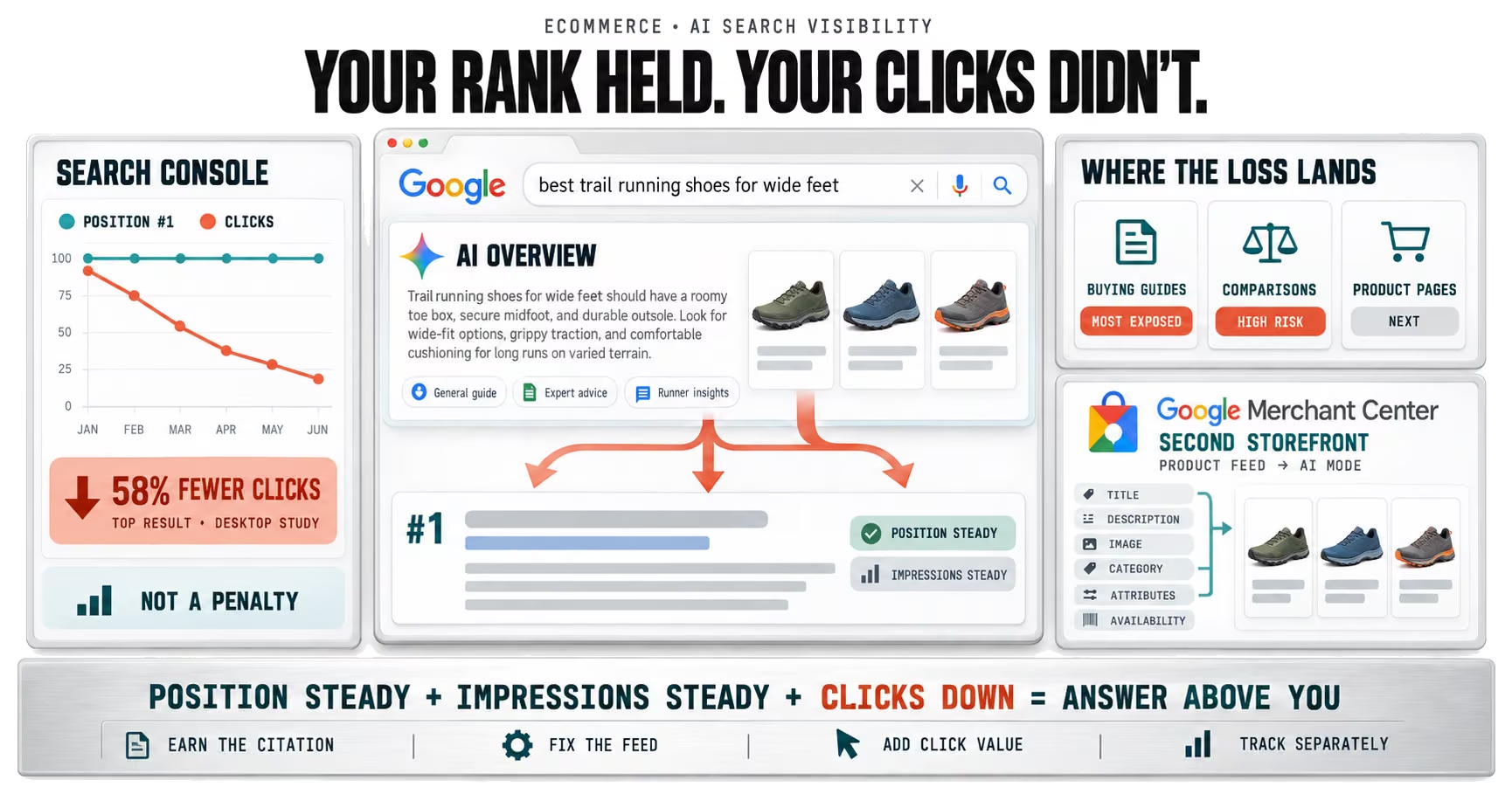
The ranking report says fine. The revenue report disagrees.
For twenty years, ecommerce SEO ran on a simple chain: rank higher, get more clicks, sell more. That chain has snapped in the middle. A category page can hold position one for months while the clicks underneath it quietly drain away.
The best large-scale evidence comes from Ahrefs, which sells SEO software and so has an interest in how search visibility is measured. According to MediaNama's coverage, Ahrefs compared desktop click-through rates on 300,000 keywords between December 2023 and December 2025. On keywords with AI Overviews, the top result lost 58% of its clicks, up from a 34.5% loss in its April 2025 study. Position two lost 50.8% and position three lost 46.4%.
| Position | Click loss |
|---|---|
| Top result | 58% |
| Second result | 50.8% |
| Third result | 46.4% |
Source: Ahrefs data on desktop click-through rates, as reported by MediaNama.
The broader trend points the same way. SparkToro, using Similarweb clickstream data, found 68.01% of U.S. Google searches ended without a click in early 2026, according to Search Engine Land. SparkToro itself cautions that its long-term comparisons use different data panels and are not directly equivalent.
Not every lost click is an AI Overview
Before you blame AI for everything, remember that zero-click search predates it. MediaNama's coverage of the Ahrefs study notes that featured snippets, local packs and top stories also pull clicks away from organic listings. AI Overviews are the newest and largest thief, not the only one.
The cleanest evidence on AI summaries specifically comes from Pew Research Center, which tracked the real browsing of 900 U.S. adults in March 2025 across 68,879 Google searches. Pew is a nonprofit with no product to sell, which is why its numbers are worth more than most.
| Behavior | With summary | Without summary |
|---|---|---|
| Clicked a result | 8% | 15% |
| Ended the session | 26% | 16% |
| Clicked a summary link | 1% | Not applicable |
Google disputes the framing. In August 2025, Head of Search Liz Reid wrote that total organic click volume has been "relatively stable year-over-year" and that Google is sending "slightly more quality clicks to websites than a year ago," meaning clicks where people do not bounce straight back.
We continue to send billions of clicks to the web every day and are committed to prioritizing the web in our AI experiences in Search.
Both things can be true. Total clicks across the web can hold steady while the clicks to your specific pages collapse. What matters for a store is which of its pages sit in the path of the answer.
Penalty or answer? Read Search Console like a detective
A penalty and an AI answer look similar on a traffic chart and completely different in Search Console. The difference is in which metric moves first.
| Symptom | Likely cause |
|---|---|
| Position and impressions steady, clicks falling | Answer above you |
| Position falling, impressions falling | Ranking problem |
| Impressions falling, position steady | Demand drop |
| Losses on brand queries | Check paid or competitors |
Search Console keeps 16 months of Performance data, so use all of it to compare the same season year over year. Then split your queries by intent. Put brand and product-name searches in one group, and question-shaped searches ("best," "how to," "vs," "is it worth") in another. If the question group's click-through rate collapsed while the brand group held, you are looking at AI answers, not a penalty.
Google's own reporting helps, with a gap. Its generative AI performance reports, rolled out globally in August 2026, show impressions in AI Overviews and AI Mode by page, country and device, but no clicks. Google's AI features documentation also says clicks from AI features are counted inside the regular Web search type, so they are blended with everything else. For turning these numbers into something leadership can read, see our guide to SEO reporting metrics for executives.
Which store pages take the hit
The damage follows the shape of the query. Pew found that AI summaries appeared on 60% of searches phrased as questions and 53% of searches of ten words or more, but only 8% of one or two word searches. Short, specific product searches were largely spared. Long, curious ones were not.
For a typical store, that makes the buying guide the most exposed page on the site. "Best trail running shoes for wide feet" or "how to choose a standing desk" is exactly the query Google can summarize from ten sources. The product page for a specific shoe, searched by name, is far safer, for now.
The "for now" matters. Semrush tracked more than 10 million keywords through 2025, and Search Engine Land reported that the mix of queries showing AI Overviews shifted sharply. Semrush owns Search Engine Land, so treat this as vendor data reported by a sister publication.
| Intent | January 2025 | October 2025 |
|---|---|---|
| Informational | 91% | 57% |
| Commercial | 8% | 18% |
| Transactional | 2% | 14% |
| Navigational | Under 1% | Over 10% |
AI Overviews are also far more common than they were. Comscore data reported by Search Engine Land found them on 39.4% of U.S. desktop searches in June 2026. The same report found YouTube, Amazon, Reddit and Wikipedia were the most cited sources for retail searches, which tells you who you are competing with for a place inside the answer.
Your Merchant Center feed is now a storefront
On a buying query, your web page is no longer the only way in. Google increasingly assembles shopping answers from structured product data, and the feed you send to Merchant Center is becoming as important as the page you rank.
In January 2026, Google announced the Universal Commerce Protocol with partners including Shopify, Etsy, Wayfair, Target and Walmart, along with "dozens of new data attributes" in Merchant Center built for conversational shopping, such as compatible accessories and substitutes. In May 2026, it added conversational attributes and AI performance insights in Merchant Center, plus a Universal Cart for buying across retailers with Google Pay.
The scale behind it is enormous. Google says AI Mode's shopping results draw on a Shopping Graph of more than 50 billion product listings, with more than 2 billion refreshed every hour. When a shopper asks for "barrel jeans that aren't too baggy," the answer is built from attributes, not from whoever has the best backlinks.
The purchase itself is moving too. In September 2026, Google began switching on native checkout in AI Mode and Gemini by default for eligible Shopify stores, as we covered in our September 21 to 25 roundup. An order placed there never touches your site, so it will not show up as an organic session at all.
The real value of being cited
If clicks are shrinking, is it worth fighting for a spot inside the AI answer? Yes, but be honest about what you are buying.
- Citation clicks are rare. Pew found users clicked a link inside an AI summary in just 1% of visits.
- Google's numbers are aggregate. Google says in its Q2 2026 earnings remarks that its AI features send billions of clicks to websites each week, but it does not break that down by site or industry.
- You cannot measure citation clicks directly. Search Console's AI reports show impressions only, so the value of a citation has to be inferred.
- Most vendor studies are desktop only. The Ahrefs figures cover desktop click-through rates, and mobile behavior may differ.
The real value of a citation is presence at the moment of decision. A shopper comparing three standing desks who sees your brand named in the answer has heard of you before they ever reach a product page. That shows up later as branded search and direct visits, not as a click from the Overview itself. Our guide to optimizing content for AI Overviews covers how to earn that placement.
Why pulling the plug backfires
It is tempting to pull the plug. Google now makes that possible: the Search generative AI control in Search Console lets a site stop appearing in AI Overviews, AI Mode and Discover's AI summaries.
Sites that opt out will not receive traffic or impressions from our generative AI features.
That warning comes from Google, as quoted by Search Engine Land. The query still gets an AI answer, assembled from your competitors. Google says the setting is not a ranking signal for regular results, but the trade is still lopsided for most stores.
The older tools do not solve it either. Google's AI features documentation says nosnippet, data-nosnippet, max-snippet and noindex control what appears in AI features, but those same controls also shrink or remove your regular search snippets. Google-Extended governs AI training in some of Google's other systems, not whether you appear in AI Overviews.
Give shoppers something a summary cannot
An AI answer can summarize what is known. It cannot hand someone the thing they came for. The pages that still win clicks are the ones where the next step only exists on your site.
- Live price and stock
- Size and fit tools
- Real customer photos
- Hands-on test results
- Configurators and calculators
- Bundles and offers
Rebuild your guides around those. A buying guide that ends with a sortable comparison of in-stock products, real test photos and a fit tool gives the shopper a reason to click that a summary cannot replace. A guide that only restates spec sheets is exactly what the AI answer already did better.
Where to start
- Split clicks from rankings. Chart impressions, position and clicks for 16 months, and segment brand queries from question-shaped queries.
- List your exposed pages. Flag buying guides, comparisons and how-to pages whose click-through rate fell while position held.
- Audit your Merchant Center feed. Fill every relevant attribute, including the new conversational ones, and fix disapprovals before optimizing copy.
- Decide on native checkout. If you sell on Shopify, choose deliberately whether AI Mode checkout stays on, and count those orders as search revenue.
- Give guides a reason to click. Add live stock, comparison tables, original photos and tools that an AI summary cannot reproduce.
- Track citations separately. Watch AI impressions in Search Console and branded search volume as your proxy for AI visibility.
Rankings used to be the scoreboard. For online stores, they are now just the ticket to be considered. The stores that win the next few years will be the ones that show up inside the answer, in the feed and on the page where the purchase actually happens.
Frequently Asked Questions
Common questions about GEO, SEO, and AI-driven search visibility.
Ahrefs analyzed 300,000 keywords and found the top-ranking page lost 58% of desktop clicks on keywords with AI Overviews between December 2023 and December 2025, as reported by MediaNama in February 2026. Pew Research found users clicked a traditional result in 8% of visits with an AI summary, compared with 15% without one. The loss is heaviest on informational pages such as buying guides rather than on product pages.
Compare impressions, average position and clicks in Search Console for the same queries. If impressions and position hold steady while clicks and click-through rate fall, the likely cause is an AI Overview or another search feature answering the query, not a penalty. A penalty or ranking problem usually shows falling positions and impressions first.
Informational pages such as buying guides, comparisons and how-to articles are hit hardest, because question-style searches trigger AI summaries most often. Pew Research found AI summaries appeared on 60% of searches phrased as questions, compared with 8% of one or two word searches. Semrush data reported by Search Engine Land shows AI Overviews spreading to commercial and transactional queries too, so product and category pages are increasingly exposed.
Yes, but mostly as visibility rather than traffic. Pew Research found users clicked a link inside an AI summary in only 1% of visits, while Google says it still sends billions of clicks to the web through its AI features. A citation puts your brand inside the answer, which matters most when the shopper is still deciding what to buy.
Usually not. Google's Search generative AI control in Search Console, rolled out globally in August 2026, removes your site from AI Overviews and AI Mode, and Google says sites that opt out will not receive traffic or impressions from those features. The AI answer still appears for the query, built from other sources, so opting out removes you rather than the answer.
Google uses Merchant Center product data in its AI shopping experiences, and in January 2026 it announced dozens of new data attributes for conversational commerce, such as compatible accessories and substitutes. AI Mode's shopping results draw on Google's Shopping Graph, which Google says holds more than 50 billion product listings. A complete, accurate feed gives AI Mode more reasons to show your products.
Sources
- MediaNama: Google AI Overviews reduce clicks by 58%, study finds (opens in a new tab)
- Search Engine Land: Google zero-click searches reach 68% in early 2026, study (opens in a new tab)
- Pew Research Center: Google users are less likely to click on links when an AI summary appears in the results (opens in a new tab)
- Google Blog: AI in Search is driving more queries and higher quality clicks (opens in a new tab)
- Google Blog: Alphabet earnings call Q2 2026, Sundar Pichai remarks (opens in a new tab)
- Search Engine Land: Google AI Overviews surged in 2025, then pulled back (opens in a new tab)
- Search Engine Land: Google AI Overviews now appear in 39% of U.S. desktop searches (opens in a new tab)
- Search Engine Land: Google Search Console AI performance reports and Search generative AI control rolling out globally (opens in a new tab)
- Google Search Central: AI features and your website (opens in a new tab)
- Google Blog: New tech and tools for retailers to succeed in an agentic shopping era (opens in a new tab)
- Google Blog: New Universal Commerce Protocol features and AI tools for retailers (opens in a new tab)
- Google Blog: AI Mode in Google Search updates, visual exploration and discovery (opens in a new tab)
- Search Engine Roundtable: Google Merchant Center Notifications For Native Checkout: Universal Commerce Protocol (opens in a new tab)