




 Preferred source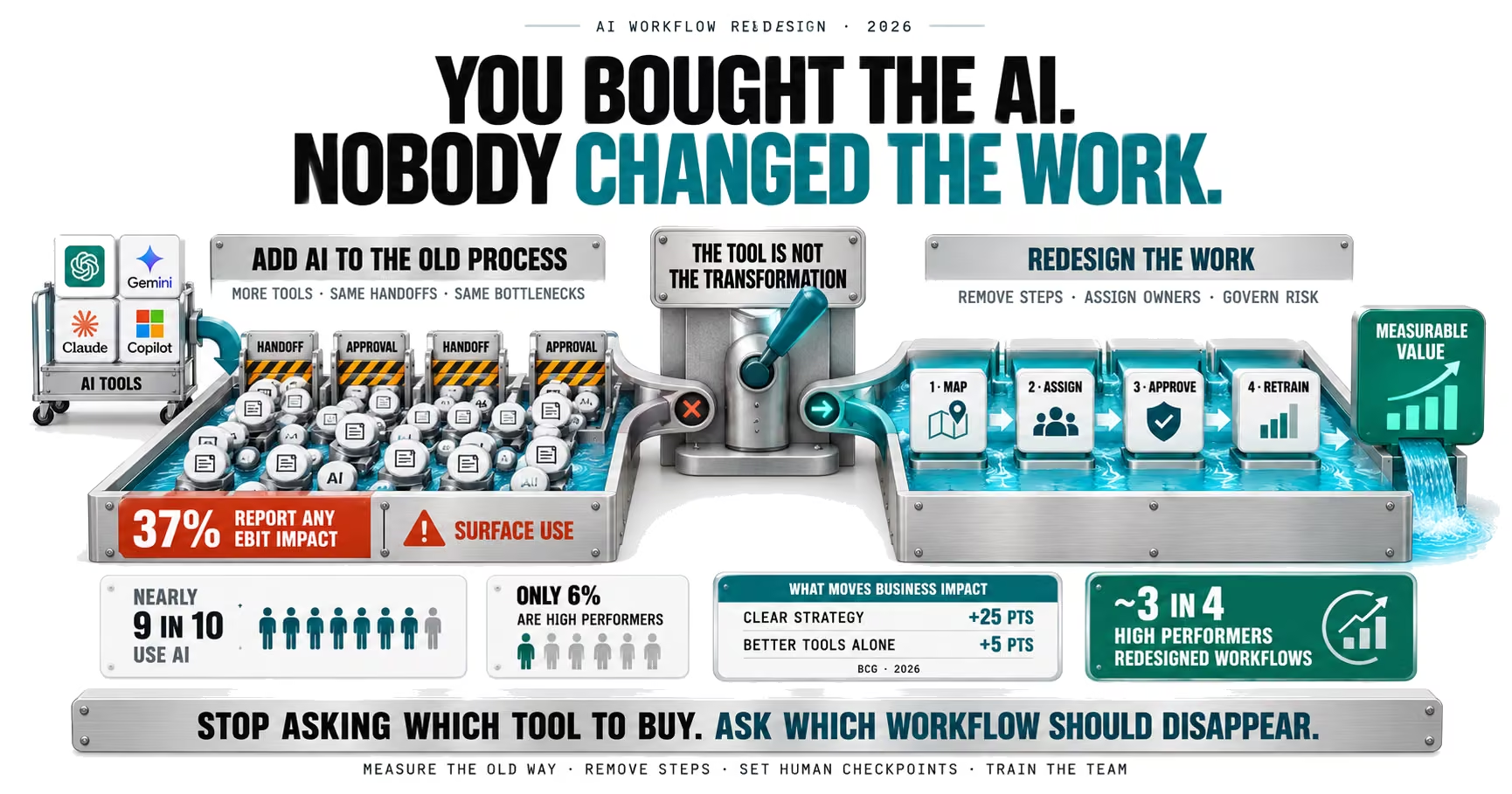
Nearly everyone has AI, and almost nobody changed the work
There is a popular way to describe AI adoption in 2026: it is like paying for a gym membership and never going. Companies buy licenses, add a few tools a vendor recommended, and then wonder why the quarterly numbers look the same. The analogy lands because it matches what the research shows.
Start with the first half of the claim, that around 90% of companies use AI. It holds up, with an important qualifier. McKinsey's State of AI in 2026, based on 1,719 respondents in 97 countries, found "nearly nine in ten respondents report regular use of AI in at least one business function." The U.S. Census Bureau tells a different story: 19.8% of U.S. firms used AI in the two weeks before its May 2026 survey, rising to 37% among firms with 250 or more employees.
| Survey | What it counts | AI use |
|---|---|---|
| McKinsey 2026 | Executives, mostly large firms | Nearly 9 in 10 |
| NBER 2026 | About 6,000 executives | 69% of firms |
| Atlanta Fed | Workers at adopting firms | About 78% |
| Census Bureau 2026 | All U.S. firms, mostly small | 19.8% |
Sources for the table: McKinsey, NBER, the Federal Reserve for the Atlanta Fed estimate, and the Census Bureau.
Both are right. A Federal Reserve note from April 2026 explains that the biggest source of the gap is "the survey goal, unit of analysis, and corresponding sample distribution." Executive surveys mostly reflect big companies; the Census counts every firm, and most firms are small. If you run a large or mid-size business, assume your competitors have AI. The question is whether they are using it differently than you.
The gap between having AI and getting value from it
The second half of the claim, that most companies have not built AI into how they work, is where the data gets sharp.
McKinsey found that 80% of respondents say AI has improved their individual productivity, but only 37% attribute any EBIT impact to it, a figure it describes as "essentially unchanged" from last year. High performers, companies getting real enterprise value, are 6% of respondents. An NBER study of nearly 6,000 executives in the U.S., U.K., Germany and Australia found 69% of firms actively use AI, yet nine in ten executives reported no impact on their firm's employment or productivity over the past three years.
Deloitte's State of AI in the Enterprise 2026, a survey of 3,235 business and IT leaders, put the problem in one sentence: 37% "report only using AI at a surface level with little or no change to underlying business processes," while only 30% are redesigning key processes around AI. And only 25% have moved 40% or more of their AI pilots into production.
Marketing is no exception. Gartner's 2026 CMO Spend Survey found CMOs now allocate an average of 15.3% of marketing budgets to AI initiatives, yet 70% say their internal marketing processes are not mature enough to implement and scale it.
The risk is that CMOs invest in AI tools faster than they build the data foundations, processes, governance and talent required to scale them.
That was Ewan McIntyre, VP Analyst at Gartner. We looked at where that hidden work ends up in why AI isn't working at your company. This article picks up the next question: what the companies getting results do differently.
What the companies getting results do differently
The pattern is consistent across every major 2026 study. The winners change the work, not just the toolset.
McKinsey reports that nearly three-quarters of its high performers have fundamentally redesigned workflows because of AI, up from 55% a year earlier, compared with about a quarter of other companies. Its description of the difference is worth reading twice.
High performers redesign workflows that are enabled by AI rather than insert AI into existing ones.
BCG reached the same conclusion from the worker side. Its 2026 AI at Work study of 11,749 workers in 14 markets found companies pursuing workflow redesign were 24 percentage points more likely to see measurable business improvement. A clear strategy lifted measurable impact by 25 points; better tools alone moved it about 5.
Microsoft's 2026 Work Trend Index, a survey of 20,000 AI users, found organizational factors such as culture, manager support and talent practices carried about twice the predictive weight of individual factors in reported AI impact. Microsoft is careful to call that an association, not proof of cause. Its section for leaders opens with a line that sums up the whole argument: "The job of every leader is to rearchitect work."
Two Wharton and University of Washington professors diagnosed the failure mode in Harvard Business Review in September 2026: companies "automate individual tasks rather than redesign the workflows that produce business value." Automating a task inside a broken process gets you a faster broken process.
The five stages companies move through
A useful way to see where you stand is as a progression through five stages. No single study measures this ladder, so the figures below come from different surveys with different samples. Treat them as signposts, not a precise funnel.
| Stage | What it means | Evidence |
|---|---|---|
| AI tools | Licenses and chat assistants for staff | Nearly 9 in 10 large firms |
| AI pilots | Experiments in a few teams | 25% moved 40%+ to production |
| AI agents | Agents doing defined tasks | 17% have deployed agents |
| AI automation | End-to-end processes run by AI | 16% of marketing work today |
| AI employees | Autonomous digital workers | Not reliable yet |
Sources for the table: McKinsey, Deloitte, Gartner's Hype Cycle for Agentic AI and Gartner's marketing automation survey.
Most companies are crowded into the first two stages. Gartner says agentic AI now "sits at the Peak of Inflated Expectations," with only 17% of organizations having deployed AI agents and more than 60% expecting to within two years. In marketing, leaders told Gartner they expect AI automation of marketing work to more than double, from 16% in 2026 to 36% by 2028.
The jump that matters is not from tools to agents. It is from adding AI to existing steps to rebuilding the process, which can happen at any stage. A team that redesigns one workflow around a simple assistant will usually outperform a team that bolts five agents onto an unchanged process.
About those 10x gains
The popular version of this argument says the companies redesigning workflows see 10x gains. That number does not survive contact with the research, and repeating it sets teams up to feel like failures when they get a solid 20%.
The best-known field study, of 5,179 customer support agents and published in the Quarterly Journal of Economics, found an assistant raised productivity by 14% on average and 34% for novice workers. The executives in the 2026 NBER study expect AI to raise their own firm's productivity by an average of 1.4% over the next three years.
Those are meaningful numbers. A 14% gain across a support team is worth a serious redesign effort. They are just not 10x, and the honest framing is that redesign turns modest, scattered individual gains into measurable business results.
Ask which workflow should disappear
Most companies start with the wrong question: which AI tool should we buy? The better question is which workflow should disappear, or at least which steps, handoffs and approvals no longer need to exist once AI can do the first draft, the research or the routing.
Here is a four-step way to rebuild one workflow, drawn from the research above.
Step one: pick one workflow and map it honestly
Choose a workflow that is frequent, measurable and painful, such as weekly reporting, content briefs or lead routing. Write down every step, every handoff between people, and how long each one takes today. Pick one and commit, rather than trialing ten tools in parallel; you need a clean before-and-after to know whether the redesign worked.
Step two: assign each task to whoever does it best
The instinct is to put a human and an AI on every task together. The evidence says that is often the worst option. A meta-analysis of 106 experiments in Nature Human Behaviour found human and AI combinations performed significantly worse on average than the best of humans or AI alone, with losses on decision tasks and a more positive pattern on creation tasks. Decide, task by task, whether AI, a person, or a combination does it best, and design accordingly.
Step three: set the human's role by the stakes
The HBR authors suggest choosing among four modes, which they call Assist, Approve, Audit and Automate, based on "the stakes and reversibility of potential errors," and designing for the "unhappy path," meaning how the system escalates exceptions and reverses mistakes. Anthropic's research on how people supervise its agents points the same way: "effective oversight doesn't require approving every action but being in a position to intervene when it matters." Low-stakes, reversible work can run with spot checks; anything client-facing or hard to undo gets a named approver.
Step four: retrain the team on the new process
Giving everyone access and hoping they figure it out is the gym membership problem in its purest form. Gartner found 80% of CMOs say staff fear and anxiety is a barrier to AI experimentation. Microsoft found 45% of AI users feel it is safer to focus on current goals than to redesign work with AI, and only 13% are rewarded for reinventing work even when results fall short. Train people on the new process step by step, have managers use it visibly, and reward the attempt as well as the result. Our guide to better AI prompts and saved context is a practical starting point for the training itself.
- Measure the old way first. Record time, cost and quality for the current workflow before changing anything.
- Remove steps before automating them. Ask which handoffs and approvals exist only because the old process needed them.
- Write the escalation rules. Define what the AI does alone, what a person approves, and how exceptions reach a named owner.
- Run old and new side by side. Compare them for a few weeks before switching fully.
Where the popular advice goes too far
The core argument is right. A few parts of the popular version are worth pushing back on before you act on them.
- "AI employees" is the wrong mental model. A large experiment reported in Harvard Business Review in May 2026 found that treating AI like a coworker reduced individual accountability, increased unnecessary escalation and lowered review quality.
- Cutting staff first tends to backfire. Gartner predicts that by 2027, 50% of companies that attributed headcount reduction to AI will rehire staff to perform similar functions.
- The survey numbers do not stack into one funnel. Adoption figures from executive surveys and the Census measure different things, so treat any single "percent of companies at each stage" chart with caution.
- Committing to one tool is not the same as locking in. Pick one platform to rebuild a workflow, but design the process so the steps, prompts and data would survive a tool change.
We have written before about what happened when companies tried to replace whole teams with AI in should AI replace your SEO team. The short answer from those cases matches the data here: redesign the work with people in it, then shrink the parts that no longer need them.
- Which of our weekly workflows has the most handoffs and the most waiting?
- If we built this process today, with AI available from day one, which steps would exist?
- Where would an AI mistake be expensive or hard to reverse?
- Who owns the exceptions when the AI is unsure?
- How will we know in 60 days whether the new workflow is better?
Where to start
- Pick one workflow this month. Choose something frequent and measurable in your marketing team, such as reporting, briefs or lead routing.
- Map it and time it. Document every step and handoff, and record a baseline for speed, cost and quality.
- Redesign before you automate. Remove steps that exist only for the old process, then assign each remaining task to AI, a person, or both based on evidence.
- Set human checkpoints by stakes. Use spot checks for reversible work and named approvers for client-facing or high-risk output.
- Train on the new process. Walk the team through it step by step, and have managers use it first and visibly.
- Measure, then expand. Compare against the baseline after 60 days, and only then move to the next workflow.
Your AI subscriptions are not the asset. The workflows you rebuild around them are. The companies pulling ahead in 2026 are not using better tools than everyone else; they are the ones willing to change how the work gets done.
Frequently Asked Questions
Common questions about GEO, SEO, and AI-driven search visibility.
It depends on who is counted. McKinsey's 2026 State of AI survey of 1,719 executives found nearly nine in ten report regular use of AI in at least one business function, while the U.S. Census Bureau found 19.8% of all U.S. firms used AI as of May 2026. A Federal Reserve note from April 2026 explains that the gap mostly comes from different samples and units of analysis, since Census counts every firm, most of them small.
Most add AI to existing work instead of changing the work. McKinsey's 2026 survey found only 37% of respondents report any EBIT impact from AI, and Deloitte's 2026 report found 37% of organizations use AI only at a surface level with little or no change to underlying processes. McKinsey says high performers redesign workflows enabled by AI rather than insert AI into existing ones.
AI workflow redesign means rebuilding a process around what AI can do, rather than adding an AI tool to each existing step. It usually removes steps and handoffs, assigns tasks to AI or people based on which does them better, and sets clear points where a person reviews or approves. McKinsey found nearly three-quarters of AI high performers have fundamentally redesigned workflows, compared with about a quarter of other companies.
Less than strategy and process changes do. BCG's 2026 AI at Work study of 11,749 workers found a clear strategy lifts measurable business impact by 25 percentage points, while better tools alone move it about 5 points. Companies pursuing workflow redesign were 24 points more likely to see measurable business improvement.
Not reliably in 2026. Gartner reported in April 2026 that only 17% of organizations have deployed AI agents, and it predicts that by 2027, 50% of companies that attributed headcount cuts to AI will rehire staff for similar work. Research published in Harvard Business Review in May 2026 also found that treating AI like a coworker reduced individual accountability and lowered review quality.
No credible study supports a general 10x gain. A study of 5,179 customer support agents published in the Quarterly Journal of Economics found a 14% average productivity increase and 34% for novice workers. An NBER survey of nearly 6,000 executives in 2026 found nine in ten reported no AI impact on productivity or employment over the past three years.
Sources
- McKinsey: The state of AI in 2026, on the road to ROI (opens in a new tab)
- U.S. Census Bureau: Large firms with at least 20 employees biggest AI users (opens in a new tab)
- Federal Reserve: Monitoring AI adoption in the U.S. economy (opens in a new tab)
- NBER: Firm data on AI (opens in a new tab)
- Deloitte: State of AI in the Enterprise 2026 (opens in a new tab)
- Gartner: 2026 CMO Spend Survey finds CMOs allocate 15.3% of marketing budgets to AI (opens in a new tab)
- BCG: AI is reshaping jobs faster than companies are reshaping work (opens in a new tab)
- Microsoft WorkLab: Agents, human agency, and the opportunity for every organization (opens in a new tab)
- Harvard Business Review: Stop automating old processes, design new ones instead (opens in a new tab)
- Gartner: Hype Cycle for Agentic AI (opens in a new tab)
- Gartner: Marketing leaders expect AI automation of marketing work to double to 36% by 2028 (opens in a new tab)
- Nature Human Behaviour: When combinations of humans and AI are useful (opens in a new tab)
- Anthropic: Measuring AI agent autonomy in practice (opens in a new tab)
- Harvard Business Review: Research, why you shouldn't treat AI agents like employees (opens in a new tab)
- Gartner: Half of companies that cut customer service staff due to AI will rehire by 2027 (opens in a new tab)
- NBER: Generative AI at work (opens in a new tab)