




GEO Is SEO, So Stop Treating Them Apart. Here Is the Real Gap
 Preferred source
Every platform describes the same entry ticket
The clearest statement comes from Google. Its 2026 guide, Optimizing your website for generative AI features on Google Search, defines AEO and GEO and then folds them back in:
"Optimizing for generative AI search is optimizing for the search experience, and thus still SEO."
Google's AI features documentation is just as direct: a page needs to be indexed and eligible to show with a snippet, and "there are no additional requirements to appear in AI Overviews or AI Mode, nor other special optimizations necessary." Danny Sullivan put it more bluntly in a WordCamp US keynote, reported by Search Engine Land: "Good SEO is good GEO, or AEO, AIO, LLM SEO, or LMNOPO."
The other platforms say much the same. Microsoft's Bing team wrote that "crawlability, metadata, internal linking, and backlinks remain essential" for discovery in AI answers, while calling them "just the starting point." OpenAI's publisher FAQ says "any public website can appear in ChatGPT search," provided its OAI-SearchBot crawler is not blocked.
The research agrees on what does not work. The Princeton and IIT Delhi paper that coined the term GEO found keyword stuffing, the oldest SEO shortcut, performed about 10% worse than no optimization at all when tested on Perplexity. We covered the overlap in detail in AI visibility is built on SEO. This post is about what to do with it.
Google has named the GEO tactics it ignores
The guide does something Google rarely does: it lists tactics by name and says they are not needed for Google Search. As Search Engine Journal noted, several of them conflict with common GEO vendor advice.
| Tactic | Google says |
|---|---|
| llms.txt files | Not needed |
| Chunked content | No requirement |
| Special schema | None to add |
| Inauthentic mentions | Less helpful than it seems |
| Long-tail rewrites | Not needed |
The guide's wording is plain: "You don't need to create new machine readable files, AI text files, markup, or Markdown to appear in Google Search." What it does recommend is what SEO has always rewarded at its best: "non-commodity" content that "provides unique expert or experienced takes that go beyond common knowledge and the ordinary," plus indexability, page experience and clean technical foundations.
Why it matters. If a separate GEO line item is mostly llms.txt files, chunked rewrites and schema for AI, Google has told you in writing that those do nothing for its AI features. That money is better spent on the content and authority work both programs need.
Where the work does diverge
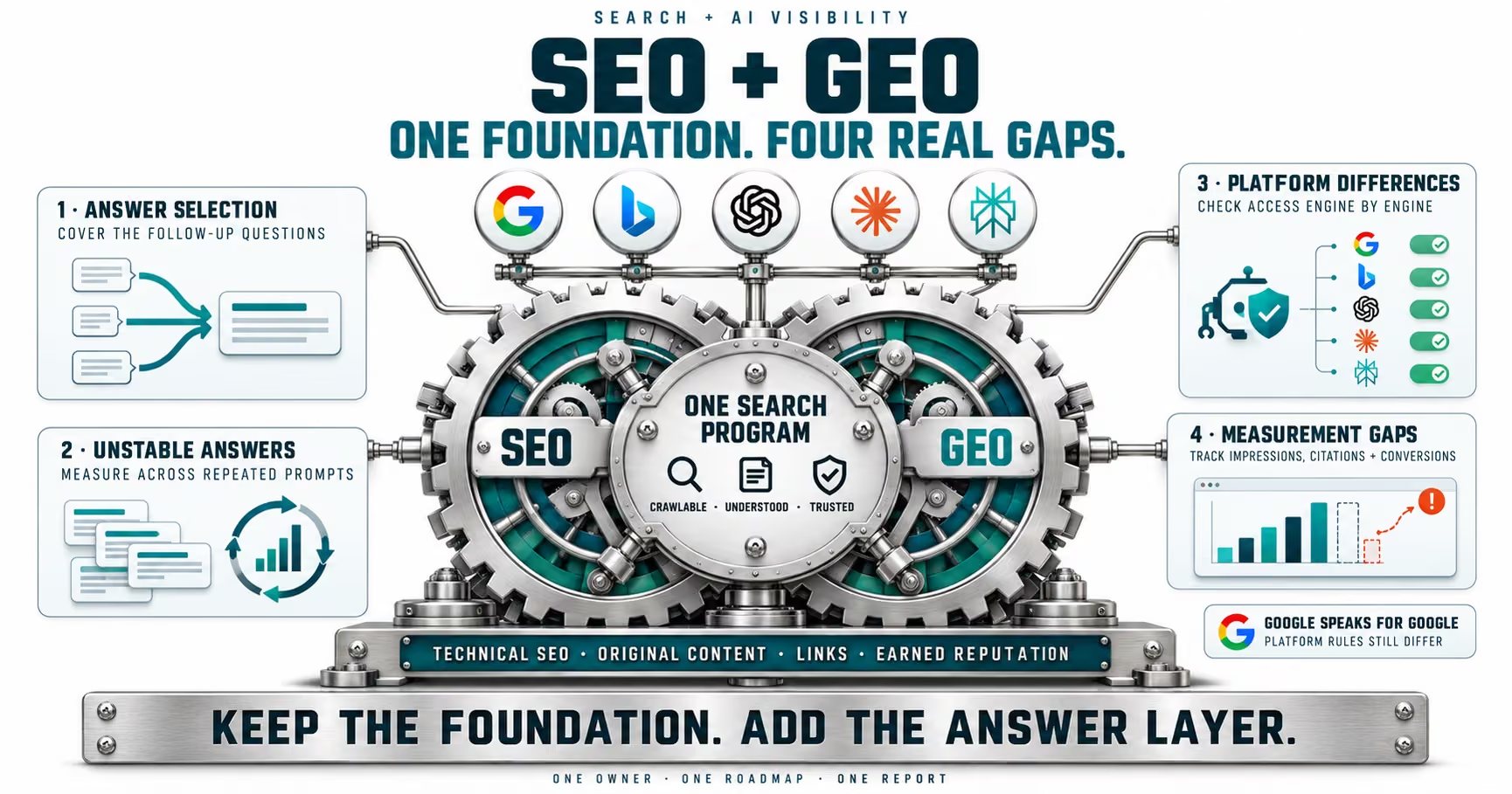
Calling GEO a separate discipline is wrong. Calling it identical to 2015 SEO is also wrong. Four gaps survive a close reading of the evidence, and each one changes what a good program does.
Gap one: you compete for a slot in an answer, not a position on a page
Microsoft's guidance explains the shift: in AI search, "ranking still happens, but it's less about ordering entire pages and more about which pieces of content earn a place in the final answer." An answer has room for a handful of sources, so visibility behaves more like a zero-sum share than a ranked list.
The GEO paper shows how sharp that can be. Adding citations to a source lifted its visibility by 115.1% when it ranked fifth in search results, while the same method cut visibility for the top-ranked source by 30.3% on average. Every source in the test had already been retrieved. The tactic reshuffled a candidate set. It did not get anyone into it.
Retrieval itself is wider than one query. Ahrefs data reported by Search Engine Journal found only 38% of AI Overview citations ranked in the top 10 for the same query, down from 76% in its July 2025 study. Ahrefs attributes much of that to query fan-out, which Google confirms it uses to run "multiple related searches across subtopics." Ahrefs also said improved parsing affects the comparison, and as a tool vendor it has a stake in rankings looking complicated.
What changes. Ranking for the head term is no longer the whole job. You need to rank for the sub-questions a fan-out would ask, which is topic coverage, a very old SEO idea applied more widely.
Gap two: answers are unstable in a way rankings never were
A study by SparkToro and Gumshoe.ai, reported by MediaPost, had about 600 volunteers run 12 identical prompts roughly 2,961 times through ChatGPT, Claude and Google's AI. ChatGPT and Google's AI had less than a 1-in-100 chance of returning the same brand list twice, and identical order came up roughly once in 1,000 runs. Gumshoe sells AI visibility tracking and SparkToro sells audience research, so both have an interest in how this kind of measurement is done.
The same study found one consulting firm appeared in 85 of 95 responses in a niche category, so stability is possible where a brand clearly owns a topic. That points to the second gap: reputation built off your site. Google warns that "seeking inauthentic 'mentions' across the web isn't as helpful as it might seem," which is a reason to earn real ones in reviews, press and expert coverage, not to skip them.
What changes. A single prompt check tells you almost nothing. Track presence across many runs and prompts, and treat earned brand coverage as part of the search program, not a separate PR budget.
Gap three: platforms disagree on the details
Google's guide says "there's no requirement to break your content into tiny pieces for AI to better understand it." Microsoft's Bing team says assistants like Copilot break content into "smaller, structured pieces that can be evaluated for authority and relevance." OpenAI's ChatGPT search help page says search queries may be shared with third-party providers such as Bing, so Bing visibility can feed ChatGPT too.
None of this calls for separate content per platform. Clear headings and sections that stand on their own serve both views without rewriting pages into fragments.
What changes. Check access and indexing platform by platform. A robots.txt rule that blocks OAI-SearchBot, or weak Bing indexing, can remove you from ChatGPT answers even when Google is fine.
Gap four: measurement is thin and has no clicks
Google's generative AI performance report in Search Console shows impressions from AI Overviews and AI Mode, and Search Engine Journal reported it reached all sites worldwide on August 31, 2026. It includes no click data. Bing's AI Performance report, still in limited testing according to Search Engine Land, counts Copilot citations, also without clicks. ChatGPT is the easiest to track, because it adds utm_source=chatgpt.com to referral links.
Clicks matter because answers absorb them. Pew Research found users clicked a traditional result on 8% of visits to Google pages with an AI summary, against 15% without one, and clicked a link inside the summary on about 1% of visits.
What changes. Classic SEO reporting runs on rankings and clicks. An integrated program also reports AI impressions, citation share across repeated prompts and referral conversions, because that is the only way to see the answer layer at all.
Why splitting the budget is the costly mistake
The traffic still runs through Google. Marie Haynes' analysis of 12 months of GA4 data across 100 sites, reported by Search Engine Land, found ChatGPT referred about 0.62% as many sessions as Google organic, and Google organic drove 27 times as many conversions as all LLMs combined. Haynes sells SEO services, and the analysis did not define how conversions were counted.
Meanwhile, Google's own AI layer keeps growing. A Semrush study reported by PPC Land found AI Overviews on 88% of 400 tracked commercial keywords by August 2026, up from 45.75% a year earlier. Semrush sells the visibility tracking it recommends, and the study counts appearances, not clicks.
Put those together and the split makes little sense. The biggest AI surface is Google, Google says optimizing for it is SEO, and the clicks that pay the bills still come from Google organic. John Mueller's advice, via Search Engine Land, is the right filter: "What you call it doesn't matter, but 'AI' is not going away," so look at your own usage data and spend accordingly.
- Google speaks for Google. Its guide covers Google Search only. ChatGPT, Perplexity and Copilot can weigh signals differently, which is why gap three exists.
- Most AI visibility data comes from vendors. Ahrefs, Semrush, SparkToro and Gumshoe all sell tools in this market, and their methods differ enough that figures rarely compare cleanly.
- The GEO paper is a lab benchmark. Its results came from a test set and a simulated engine, plus a Perplexity check, not from live business sites.
Putting this to work
Build one program with one owner. Start from the foundation in our SEO build order for AI search, then add the four pieces that answer engines reward.
- Cut the tactics Google has named. Drop llms.txt projects, chunked rewrites and AI-only schema from any Google-focused scope, and move that budget to original content and technical fixes.
- Map the fan-out for your top topics. For each money page, list the sub-questions an AI answer would need, and make sure you rank for them, not only for the head term.
- Earn reputation off your site. Put reviews, expert quotes, press coverage and analyst mentions in the same plan as content, because answers lean on what others say about you.
- Check access on every platform. Confirm OAI-SearchBot is allowed, your key pages are indexed in Bing, and nothing in robots.txt or your CDN blocks AI search crawlers you want.
- Report the answer layer next to rankings. Add Search Console AI impressions, ChatGPT referral sessions and conversions, and citation share across repeated prompts to the monthly report.
The labels will keep multiplying. The work underneath has not split, and the companies that keep winning are the ones that stop paying two teams to argue about one foundation, then fund the few things answer engines add on top.
Frequently Asked Questions
Common questions about GEO, SEO, and AI-driven search visibility.
Mostly no. Google's 2026 guide to generative AI search says optimizing for it is still SEO, and its AI features documentation says there are no additional requirements to appear in AI Overviews or AI Mode. The remaining differences are in how answers are assembled, how stable they are, how platforms differ and how results are measured.
Not for Google. Google's guide to optimizing for generative AI features says you don't need new machine-readable files, AI text files, markup or Markdown to appear in Google Search, and there is no special schema.org markup to add. Structured data still helps with rich results.
Google says no: its guide states there is no requirement to break content into tiny pieces for AI to understand it. Microsoft's Bing team says assistants like Copilot break content into smaller, structured pieces and evaluate each one. Clear headings and self-contained sections serve both without rewriting pages into fragments.
Less than they used to. Ahrefs data reported by Search Engine Journal in March 2026 found 38% of AI Overview citations ranked in the top 10 for the same query, down from 76% in its July 2025 study, though Ahrefs said improved parsing affects the comparison. Ahrefs attributes much of the gap to query fan-out, where Google runs related sub-queries.
Not very. A SparkToro study with Gumshoe.ai, reported by MediaPost, ran 12 prompts about 2,961 times and found less than a 1-in-100 chance that ChatGPT or Google's AI would return the same brand list twice. Results were more stable in smaller, niche markets.
Start with first-party tools. Google's Search Console generative AI report, available to all sites since August 31, 2026, shows impressions from AI Overviews and AI Mode but no clicks. ChatGPT adds utm_source=chatgpt.com to referral links, so its visits show up in analytics.
Sources
- Google Search Central: Optimizing your website for generative AI features on Google Search (opens in a new tab)
- Search Engine Journal: Google's new AI search guide calls AEO and GEO still SEO (opens in a new tab)
- Google Search Central: AI features and your website (opens in a new tab)
- Search Engine Land: Google's Danny Sullivan, good SEO is good GEO (opens in a new tab)
- Search Engine Land: Google's John Mueller on SEO vs. GEO, focus on audience behavior (opens in a new tab)
- Microsoft Advertising: Optimizing your content for inclusion in AI search answers (opens in a new tab)
- OpenAI Help Center: Publishers and developers FAQ (opens in a new tab)
- OpenAI Help Center: ChatGPT search (opens in a new tab)
- arXiv: GEO, Generative Engine Optimization (opens in a new tab)
- Search Engine Journal: Google AI Overview citations from top-ranking pages drop sharply (opens in a new tab)
- MediaPost: AI brand recommendations, chaotic, inconsistent (opens in a new tab)
- Search Console Help: Generative AI performance report (Search) (opens in a new tab)
- Search Engine Journal: Google Search Console AI reports rolled out worldwide (opens in a new tab)
- Search Engine Land: Bing Webmaster Tools testing new AI Performance report (opens in a new tab)
- Pew Research Center: Google users are less likely to click on links when an AI summary appears in the results (opens in a new tab)
- Search Engine Land: ChatGPT sends less than 1% of Google's traffic: Data (opens in a new tab)
- PPC Land: Google AI Overviews now hit 88% of tracked commercial keywords, Semrush finds (opens in a new tab)