



Google Just Pre-Announced a Core Update. Here Is What Changed
 Preferred source
Two core update notices, one hour apart
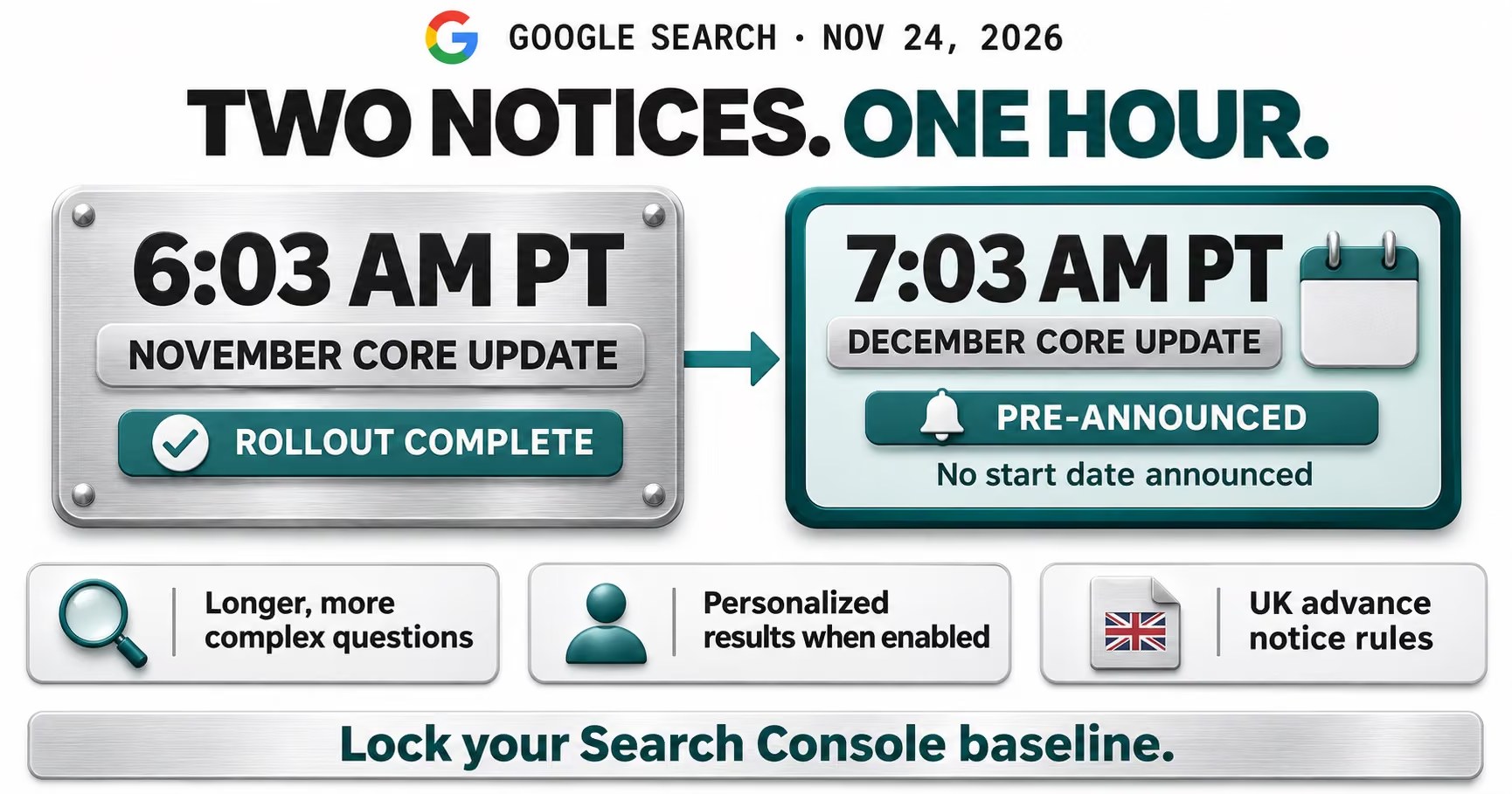
Core updates usually arrive without warning and end with a one-line status note. This week Google did something different. The Search Status Dashboard shows the November 2026 core update began on November 10 at 10:06 a.m. Pacific and ended on November 24 at 6:03 a.m. Exactly an hour later, a new dashboard entry pre-announced the December 2026 core update. Search Engine Journal was among the first to note the two posts landed approximately an hour apart.
That makes December the fourth announced core update of 2026, and the first with advance notice.
| Update | Rollout | Duration |
|---|---|---|
| March 2026 | Mar 27 to Apr 8 | 12 days |
| May 2026 | May 21 to Jun 2 | About 12 days |
| November 2026 | Nov 10 to Nov 24 | 14 days |
| December 2026 | Not yet scheduled | Unknown |
The March dates come from Search Engine Journal's completion report, and the May dates from its coverage of that rollout. November ran the longest of the year, and Search Engine Roundtable's wrap-up puts it at 14 days, the full two weeks Google had said it might take. We tracked that rollout in our November 16 to 20 roundup, when ranking chatter was unusually muted.
What Google says the December update will change
For the first time in a long while, Google has told site owners what a core update is meant to improve before it ships. The dashboard entry says the update:
"focuses on multiple improvements to how our systems understand and rank relevant content (including for longer and more complex questions)"
It also covers personalization. Google says the update improves personalized results for people who have personalization turned on, and that it applies to all locations and languages where Google Search is available. The only timing is this line:
"This update is scheduled to be released in December 2026."
A Google spokesperson told Search Engine Roundtable that there is no date yet, that Google will announce it the day it starts rolling out, and that "It's not imminent." The same report noted that the status page listed the December entry as an active incident even though the update had not started, and that Google confirmed it was not live.
Why it matters. Longer, more complex questions are the queries that AI Mode and AI Overviews were built for, and they are the queries where a page that answers one narrow question tends to lose to a page that handles the whole problem. Personalization is the second signal. If more results depend on a signed-in user's history, the rankings your tools report will drift further from what your customers see.
The UK is why you got a warning
Google did not volunteer this change. The UK's Competition and Markets Authority designated Google with strategic market status in general search services on October 10, 2025, and imposed a fair ranking conduct requirement on June 17, 2026. That requirement obliges Google to give publishers sufficient notice and information about material changes that could affect them.
The CMA's final decision sets the floor:
"a minimum of 30 business days' notice before actionable changes are introduced in the UK, and 15 business days' notice before significant and explainable changes."
The same decision cites a recent Discover core update as the kind of change that would likely count as significant and explainable. Google's new stay-informed documentation, last updated November 24, now reflects the rule: "for changes where UK users may experience a significant ranking shift, we provide advance notice to site owners."
If the 15-business-day minimum applies to this update, counting from November 24 puts the earliest UK rollout at December 15. That is our arithmetic, not a Google date, and Google applies the update globally, so the notice protects everyone.
Google has flirted with this before. In June 2019 it posted a one-day warning before a broad core update. Asked whether pre-announcements would continue, Google's Danny Sullivan replied at the time: "We probably will. But you won't be able to 'fix' anything." Since then, Google's core updates have been announced on the day they start, including March, May and November of this year. Regulation, not preference, is what brought the warning back.
Google also opened a ranking hub and a feedback button
The pre-announcement came with new documentation. Google launched a Search Ranking Hub on Search Central the same day, which says Google publishes advance notice of actionable policy changes and significant ranking updates on the Search Status Dashboard. Search Engine Roundtable described it as a unified ranking transparency hub.
Google also published three principles for ranking results: users come first, systems are consistent across all result types, and standards are upheld through rigorous testing. The page says Google makes no manual ranking adjustments except to comply with legal obligations or enforce its content policies.
The most useful addition is a feedback process. After a significant ranking change listed on the dashboard, verified site owners can click Submit Feedback in Search Console and tag the update with a hashtag such as #NovemberCoreUpdate2026. Google asks for queries, example URLs, competing URLs that rank inappropriately and before-and-after data.
"Engineering teams review submissions in aggregate to identify systemic issues"
Set expectations accordingly. Google says the feedback does not result in manual ranking adjustments for individual URLs. It is a channel for reporting patterns, not an appeal.
Personalization will make rank tracking less reliable
Google's help page on why results differ between people says personalization uses information in a person's Google Account, such as Search history, and is only used when it is likely to be more helpful. It can reorder results or content blocks, and users can switch it off. Location, language and device still shape results either way.
Rank trackers check results from a clean, signed-out position. If the December update leans harder on personalization, the gap between a tracked position and what a signed-in customer sees will widen. Search Console, which reports real impressions and clicks, becomes the more trustworthy view. Our guide to E-E-A-T in AI search covers the content signals that hold up regardless of who is searching.
How to read November's data during Thanksgiving week
Google's core updates guidance says to wait at least a full week after a rollout completes, then compare with the week before the update began. Search Engine Journal suggested comparing November 25 to December 1 against November 3 to 9. That window includes Thanksgiving, Black Friday and Cyber Monday, so raw traffic comparisons will mislead most businesses.
- Holiday demand distorts the week. Shopping and travel behavior shifts around Thanksgiving for many businesses, so compare average position and click-through rate, not total clicks.
- December may overlap your read. If the next update starts in mid-December, you may have only one or two clean weeks of post-November data.
- Tracking tools struggled this time. Search Engine Roundtable reported quieter-than-usual chatter in November and suspected third-party trackers were having trouble monitoring the changes.
- Small drops are not a verdict. Google's guidance says a move from position 2 to 4 does not call for drastic action, while a fall from position 4 to 29 warrants a deeper review.
Separate a core update loss from other causes before you act on it. A spam update or a manual action needs a different response from a core update, and a seasonal dip needs none at all.
What to do before December rolls out
- Lock a pre-December baseline now. Export Search Console query and page data for the last 28 days, segmented into branded and non-branded queries, so December's impact can be measured cleanly.
- Measure November against November 3 to 9. Compare average position and click-through rate by page group rather than total clicks.
- Find your longest queries. Filter Search Console for queries of six or more words and check which pages answer them fully and which answer only part of the question.
- Subscribe to the dashboard feed. Add the Search Status Dashboard RSS feed to your team's alerts so the rollout start does not catch you off guard.
- File feedback where you see a pattern. If November cost you rankings to pages that answer queries worse, use the Search Console feedback button with the #NovemberCoreUpdate2026 tag and specific examples.
Advance notice does not tell you what to fix. It tells you when to measure. The teams that lock their baseline this week will know within days what December changed, while everyone else is still arguing with a holiday traffic chart.
Frequently Asked Questions
Common questions about GEO, SEO, and AI-driven search visibility.
Google has not given a date. Its Search Status Dashboard entry, posted November 24, 2026, says only that the update is scheduled to be released in December 2026, and a Google spokesperson told Search Engine Roundtable that it is not imminent and will be announced the day it starts rolling out.
Google's Search Status Dashboard says the December 2026 core update focuses on improving how its systems understand and rank relevant content, including for longer and more complex questions. It also aims to improve personalized results for people who have personalization turned on. It applies to all locations and languages where Google Search is available.
Google's new stay-informed documentation says it gives advance notice to site owners for changes where UK users may experience a significant ranking shift. That follows the UK Competition and Markets Authority's fair ranking conduct requirement, imposed June 17, 2026, which sets minimum notice of 15 business days before significant and explainable ranking changes and 30 business days before actionable changes.
Google's Search Status Dashboard says the November 2026 core update began on November 10, 2026 at 10:06 a.m. Pacific and was complete as of November 24, 2026 at 6:03 a.m. Pacific, a rollout of about 14 days. Google recommends waiting at least a full week after completion before analyzing the impact in Search Console.
Yes. Google's submit feedback documentation, published November 24, 2026, lets verified site owners send feedback from Search Console after a significant ranking change listed on the Search Status Dashboard, tagged with a hashtag such as #NovemberCoreUpdate2026. Google says engineers review submissions in aggregate and that feedback does not lead to manual ranking adjustments for individual URLs.
Google's core updates documentation recommends waiting at least a full week after an update completes, then comparing Search Console data with the week before the rollout started. Google says a small drop, such as from position 2 to 4, calls for no drastic action, while a large drop calls for a deeper content assessment.
Sources
- Search Engine Journal: Google Confirms November 2026 Core Update Is Complete (opens in a new tab)
- Search Engine Roundtable: Google November 2026 Core Update Ranking Flux, What We're Seeing (opens in a new tab)
- Google Search Status Dashboard: November 2026 core update (opens in a new tab)
- Google Search Status Dashboard: December 2026 core update (opens in a new tab)
- Search Engine Journal: Google Announces December 2026 Core Update Ahead Of Rollout (opens in a new tab)
- Search Engine Roundtable: Google December 2026 Core Update Preannounced, Complex Queries & Personalization (opens in a new tab)
- Search Engine Roundtable: Google November 2026 Core Update Has Completed Rolling Out (opens in a new tab)
- Search Engine Journal: Google Confirms March 2026 Core Update Is Complete (opens in a new tab)
- Search Engine Journal: Google's May Core Update Complete After Volatile Rollout (opens in a new tab)
- Google Search Central: How to Stay Informed on Google Search Ranking Updates (opens in a new tab)
- GOV.UK: Google's general search and search advertising services (opens in a new tab)
- Competition and Markets Authority: Fair Ranking Conduct Requirement, Google's general search services (opens in a new tab)
- GOV.UK: Google search fair ranking conduct requirement (opens in a new tab)
- Search Engine Roundtable: Google To Pre-Announce Future Core Search Algorithm Updates (opens in a new tab)
- Search Engine Roundtable: Google Pre-Announces June 2019 Core Update (opens in a new tab)
- Google Search Central: Google Search Ranking Hub (opens in a new tab)
- Google Search Central: Our Principles for Ranking Results (opens in a new tab)
- Google Search Central: Submit Feedback About Ranking Changes in Google Search (opens in a new tab)
- Search Engine Roundtable: New Google Search Ranking Hub, Ranking Principles, Feedback & AI Training Control (opens in a new tab)
- Google Search Help: Why your Google Search results differ from others (opens in a new tab)
- Google Search Central: Google Search's Core Updates (opens in a new tab)