


AI Doesn't Rank Your Website. It Decides Whether to Vouch for You
 Preferred source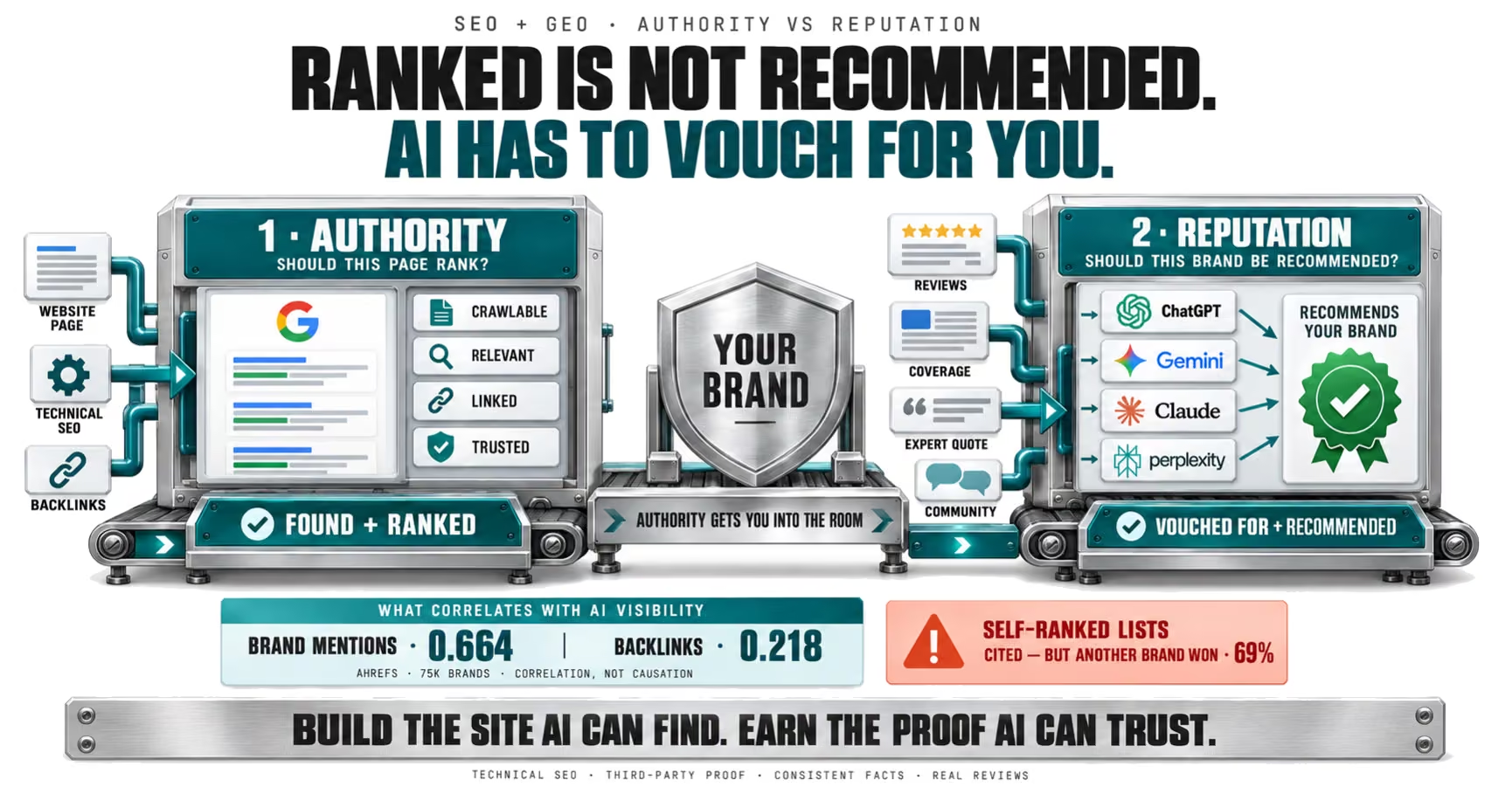
Two questions, one system
Search used to ask one main question about a website. AI adds a second. Authority asks, "Should this page rank?" It is built through backlinks, domain strength, relevant content and technical SEO, and it is optimized for Google rankings. Reputation asks, "Should this brand be recommended?" It is built through brand mentions, reviews, "best X" lists, industry sites and community discussion, and it is optimized for AI recommendations.
The distinction matters. A ranked list of ten links lets the searcher decide. An AI answer makes the decision for them, and it usually names brands rather than pages. When a buyer asks ChatGPT for the best payroll software for a 50-person company, the question the system has to answer is not which page is most relevant. It is which company it is willing to put its name behind.
The mistake is treating these as two separate programs. AI search tools do not invent their answers from nothing. Google says there are no additional requirements to appear in AI Overviews or AI Mode beyond being indexed and eligible for a snippet. OpenAI says sites that block its search crawler "will not be shown in ChatGPT search answers." Microsoft's Bing team says backlinks and other SEO fundamentals remain essential for content to be discoverable by its AI. Authority gets you into the room. Reputation decides whether you get picked once you are there.
We made the same point about a different viral chart in Getting found vs. getting cited: the two halves are one root system, not two trees.
Reputation was always in the algorithm
The idea that SEO used to be about authority and is now becoming about reputation is only half right. Reputation has been part of how Google judges quality for a long time. It just used to be measured indirectly.
Links were the original reputation signal. Google describes one of its quality factors as whether "other prominent websites link or refer to the content". A link was a vote from one site to another. "Domain strength," on the other hand, was never a Google concept. Google's John Mueller said in 2020 that Google does not use domain authority "at all" in its algorithms. It is a score invented by SEO tool vendors to approximate link reputation.
Google's human raters have been checking reputation directly. Section 3.3 of the Search Quality Rater Guidelines, dated September 11, 2025, tells raters to research the reputation of websites and content creators, and to be:
Skeptical of claims that websites make about themselves, particularly when there is a clear conflict of interest.
Raters are told to look for independent reviews, references, recommendations by experts and news articles, and the guidelines name Wikipedia articles, magazine articles and forum discussions as useful sources. The same document says the most important part of E-E-A-T is trust.
Read the authority vs. reputation chart against that and the "reputation" column is almost a summary of Google's rater guidance. What changed is not the importance of reputation. What changed is that an AI answer surfaces the reputation judgment directly to the buyer, in the form of a named recommendation, instead of hiding it inside a ranking.
Why AI leans harder on reputation
There are three reasons the reputation layer matters more in AI answers than it did in ten blue links.
First, AI systems summarize what the web says about you. An Ahrefs study of 75,000 brands found branded web mentions correlated with AI Overview brand visibility at 0.664, branded anchors at 0.527 and branded search volume at 0.392. Backlinks came in at 0.218 and referring domains at 0.295. Brands in the top quartile for mentions averaged 169 AI Overview mentions, more than ten times the next quartile. Ahrefs sells SEO tools and this is correlation, not proof of cause, but the gap is wide.
Second, fame compounds. Research by Google and Tracksuit published in June 2026 found that for brands around 30% awareness, each five-point rise in awareness came with roughly a five-point rise in share of search. Google sells advertising and Tracksuit sells brand tracking, so both have a stake. The pattern is still consistent: the more people know and talk about a brand, the more often systems built on that conversation repeat it.
Third, buyers check the answer against other people's experience. BrightLocal's 2026 survey of 1,002 US consumers found 45% had used AI tools for local business recommendations, up from 6% a year earlier. Among those users, 97% said they at least sometimes double-check AI recommendations against real reviews. BrightLocal sells local SEO software, but the behavior it describes matters: a recommendation that does not survive a look at the reviews does not convert.
And when a recommendation does appear, it often replaces the click. Pew Research found that users clicked a link inside Google's AI summary on just 1% of visits where one appeared. If the answer names a competitor, you may never get the chance to make your case.
The reputation checklist, checked
Most reputation work falls into five activities. Each has evidence behind it. Two need guardrails.
| Signal | Verdict | Guardrail |
|---|---|---|
| Reviews across the web | Strong | Only genuine, unincentivized reviews |
| Industry brand mentions | Strong | Earned coverage, not paid placements |
| "Best X" listicles | Mixed | Third-party lists, not self-ranked ones |
| Reddit and forums | Mixed | Honest participation, weight is shifting |
| Information AI can understand | Strong | Accurate, consistent first-party facts |
Reviews have to be real
Reviews are the most direct reputation signal a buyer sees, and the one most often gamed. Google's Maps content policy says contributions should "reflect a genuine experience" and removes reviews that have been paid for or incentivized. It also prohibits businesses from discouraging negative reviews or selectively soliciting positive ones. In the US, the FTC's final rule on fake reviews, announced August 14, 2024, bans fake reviews and testimonials and the purchase of fake indicators of social media influence. Ask every customer, make it easy, and respond to criticism in public.
Brand mentions have to be earned
Mentions on relevant industry sites carry weight because someone else chose to write them. That is also why paid placements dressed up as editorial work against you if they are discovered, and why the rater guidelines tell reviewers to discount what a site says about itself. Original research, expert commentary and real customer stories are what earn mentions that last.
The listicle trap
"Best X" and comparison lists show up constantly in AI answers, so brands want to be on them. Being included in an independent comparison is valuable. Publishing your own "best X" list with yourself in first place is a different tactic, and the evidence on it is poor.
In June 2026, Search Engine Land reported a study of 100 B2B "best software" queries checked in Google AI Overviews over two months. Self-promotional listicles were cited 323 times, but in about 69% of those cases Google cited the brand's own page without recommending that brand. In one example, a learning management system's self-ranked list was cited for "best LMS for selling courses," while the answer recommended four competitors. The study observed that brands with wide third-party mentions were more likely to be recommended.
- The sample is small. The study covered 100 queries in B2B software across three checkpoints, so it shows a pattern, not a rule for every category.
- Google has not commented. The explanation for which brands get recommended is the researcher's observation, not a confirmed Google criterion.
- Comparison pages are not banned. An honest comparison that names a competitor as the better fit for some buyers is useful content. A list built to rank yourself first is the problem.
The logic is the same as the rater guidelines. A list where the publisher ranks itself first is a claim a site makes about itself, with a clear conflict of interest. AI systems can cite it as a source of category information and still refuse to take its conclusion at face value.
Reddit is a community, not a channel
Reddit, forums and niche communities are the other place brands are told to show up. Communities matter because they are where buyers compare notes. But their weight inside AI answers is shifting. Search Engine Land reported Promptwatch data showing Reddit's share of ChatGPT search citations fell from 3.83% to 0.52% in mid-August 2026, a finding the vendor called provisional.
The bigger risk is how brands try to show up. We covered an AI visibility company whose bot-built subreddits climbed in AI citations and were then removed by Reddit in a single action in Reddit banned a GEO experiment. The reputation that survives is the kind real people give you. Answer questions under your own name, disclose who you work for, and follow each community's rules.
AI recommendations are a lottery you can only measure in aggregate
One more reason not to treat reputation like a ranking: AI recommendations are not stable. MediaPost reported a January 2026 study by SparkToro and Gumshoe in which 600 volunteers ran 12 identical prompts through ChatGPT, Claude and Google's AI about 2,961 times. ChatGPT and Google's AI had less than a 1 in 100 chance of returning the same list of brands in any two runs, and identical ordering appeared about once in 1,000 runs. Smaller markets, such as regional service providers and niche B2B tools, produced more stable results. SparkToro and Gumshoe both sell research and tracking tools.
That changes how reputation should be measured. A single screenshot of ChatGPT naming you, or not naming you, means little. What matters is how often you appear across a fixed set of buyer prompts, on several platforms, tracked over months. Reputation is a share, not a position.
How we build reputation without gaming it
At Silverback, we do SEO, GEO and AI visibility without gaming the systems. That rules out the shortcuts that tend to follow any new signal: fake or incentivized reviews, bought mentions, self-ranking listicles and manufactured community posts. Every one of them is a claim a brand makes about itself, wearing someone else's clothes, and every one of them gets discounted once the systems catch up.
What we do instead is build both layers in order. First, a site that search engines and AI systems can crawl, read and trust, with accurate facts, named experts and evidence. Then a reputation program that gives other people reasons to talk about the brand: original research worth citing, customer outcomes worth reviewing, and experts worth quoting. Our breakdown of AEO and GEO trust signals covers the technical side in more detail.
Where to start
- Ask the reputation question directly. Run your top ten buyer prompts across ChatGPT, Gemini, Claude and Perplexity at least five times each, and record which brands appear and what is said about them.
- Fix review velocity before review volume. Set up a simple, consistent ask after every completed job or purchase, on the platforms your buyers use, and respond publicly to every negative review.
- Replace self-ranking lists with honest comparisons. Rewrite "best X" pages that rank you first into comparisons that say who you are and are not the right fit for.
- Give people something to cite. Publish one piece of original data or expert analysis a quarter that industry sites and journalists would want to reference.
- Make your facts consistent everywhere. Align your name, services, pricing and claims across your site, profiles, directories and press materials so every source tells the same story.
- Keep the authority layer healthy. Crawlable pages, open AI search crawlers and relevant links still decide whether AI systems find you in the first place.
Search rankings still matter, and they still feed the systems that make AI recommendations. But an AI answer is a referral, and referrals go to the brands other people vouch for. Build the site that earns the ranking, then earn the reputation that turns the ranking into a recommendation.
Frequently Asked Questions
Common questions about GEO, SEO, and AI-driven search visibility.
Authority is about whether a page deserves to rank, built through links, relevant content and technical health. Reputation is about whether a brand deserves to be recommended, built through reviews, mentions and independent coverage. Google's Search Quality Rater Guidelines have long asked raters to research reputation through independent sources, so the two have always overlapped.
Correlation data points that way. An Ahrefs study of 75,000 brands found branded web mentions correlated with AI Overview brand visibility at 0.664, compared with 0.218 for backlinks. Ahrefs sells SEO tools and the study shows correlation, not cause, but backlinks still help pages get discovered and ranked.
Reviews shape how buyers check AI answers. BrightLocal's 2026 survey found 45% of US consumers used AI tools for local business recommendations, and 97% of those users sometimes double-check recommendations against real reviews. Reviews must be genuine: Google removes paid or incentivized reviews, and the FTC's 2024 rule bans fake reviews.
It is a risky tactic. A study of 100 B2B software queries reported by Search Engine Land in June 2026 found Google AI Overviews cited self-promotional listicles 323 times but did not recommend the publishing brand in about 69% of those cases. Earning a place in independent comparisons is the stronger play.
It matters, but its weight is shifting. Search Engine Land reported Promptwatch data showing Reddit's share of ChatGPT search citations fell from 3.83% to 0.52% in mid-August 2026, a provisional vendor finding. Participate honestly in communities where your customers talk rather than treating Reddit as a ranking hack.
Measure share across many runs, not single answers. SparkToro and Gumshoe found ChatGPT and Google's AI had less than a 1 in 100 chance of returning the same list of brands in any two runs of the same prompt, as MediaPost reported in January 2026. Track how often you appear across a fixed prompt set over time.
Sources
- Google: Search Quality Rater Guidelines (opens in a new tab)
- Google: How Google Search determines ranking results (opens in a new tab)
- Search Engine Roundtable: Google Still Uses PageRank & No, Google Does Not Use Domain Authority (opens in a new tab)
- Google Search Central: AI features and your website (opens in a new tab)
- Microsoft Advertising: Optimizing Your Content for Inclusion in AI Search Answers (opens in a new tab)
- Ahrefs: An Analysis of AI Overview Brand Visibility Factors (75K Brands Studied) (opens in a new tab)
- LBBOnline: Brand Awareness Proven to Drive Share of Search, Google and Tracksuit Study Finds (opens in a new tab)
- BrightLocal: Nearly Half of Consumers are Asking AI for Business Recommendations (opens in a new tab)
- Pew Research Center: Google users are less likely to click on links when an AI summary appears in the results (opens in a new tab)
- Google: Maps User Generated Content Policy, Prohibited and restricted content (opens in a new tab)
- Federal Trade Commission: Federal Trade Commission Announces Final Rule Banning Fake Reviews and Testimonials (opens in a new tab)
- Search Engine Land: Google AI Overviews cite self-serving listicles, but recommend competitors 69% of the time (opens in a new tab)
- Search Engine Land: Reddit's ChatGPT Search citations fell 86% in four days: Report (opens in a new tab)
- MediaPost: AI Brand Recommendations: Chaotic, Inconsistent (opens in a new tab)
- OpenAI: Overview of OpenAI crawlers (opens in a new tab)