


AI Training Opt-Outs, AI Mode Ads and Earnings: Oct 26 to 30, 2026
 Preferred source
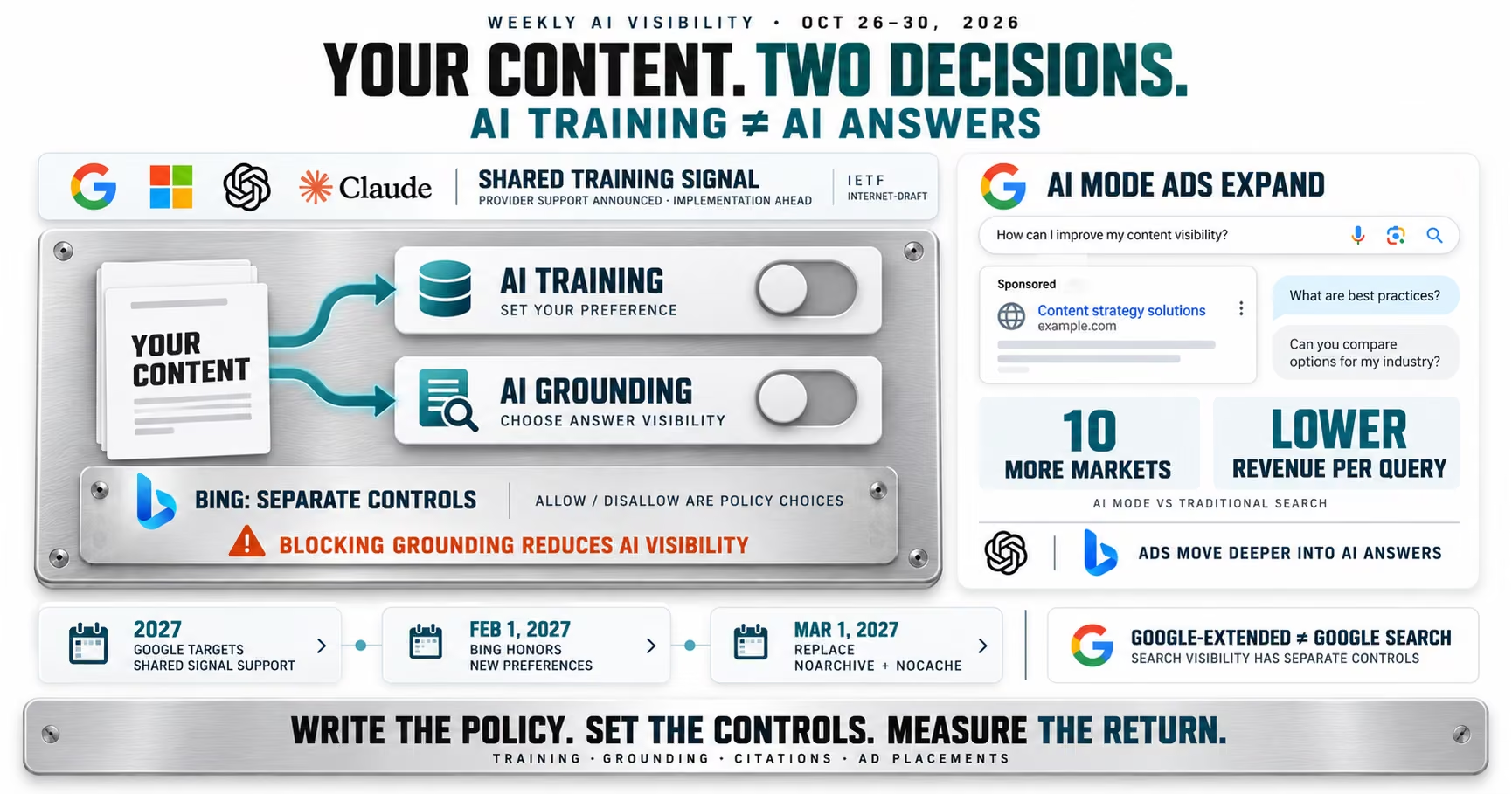
Control finally moved past one switch per crawler
Last week we wrote that robots.txt cannot say no to training. It is an access protocol, and blocking AI use meant chasing one crawler token at a time. This week the major AI providers agreed to give site owners a shared vocabulary instead, and Microsoft added a second dial for AI answers.
That pairs with a commercial week that showed where Google is heading. AI Mode usage is growing faster than its ad revenue, so Google is expanding ads inside it, and its rivals are doing the same. The question for marketers is no longer whether AI surfaces matter. It is which uses of your content you allow, and what you get back for it.
One robots.txt line for AI training across providers
Google announced on its Search Central blog that it plans to support "a shared AI training control in robots.txt," based on work from the AIPREF working group at the Internet Engineering Task Force. The post, written by John Mueller, says website owners will be able to use a shared "policy token" to set preferences "across participating AI providers" instead of managing separate instructions for each company.
The mechanics come from an IETF Internet-Draft that binds usage preferences to paths using ordinary robots.txt groups. The draft's example uses User-Agent: __usage_ai-training followed by normal Disallow and Allow lines. Two details matter. A wildcard User-Agent: * group must not be read as matching the token, and if the token is missing, no preference has been expressed at all.
Google's interpretation is specific:
When a website uses this policy token to opt out of training in its robots.txt file (and Google-Extended is not explicitly specified), Google plans to interpret that as if the publisher had disallowed Google-Extended.
Company controls keep working alongside the shared token. Google says sites that explicitly allow Google-Extended stay eligible to appear and receive clicks through grounding in Gemini Apps. Google aims to support the control "along with other AI providers in 2027." Search Engine Roundtable reported that OpenAI and Anthropic have signaled support for the same proposal, and Microsoft confirmed it in its own announcement.
Why it matters. For years, an AI training policy meant maintaining a list of crawler names that kept growing. A shared token turns that into one decision. It does not change Google Search: Google-Extended has never controlled AI Overviews or AI Mode, and this signal maps to Google-Extended. If your goal is to stay out of AI answers in Google Search, the relevant lever is still the Search generative AI control in Search Console, with the visibility cost that comes with it.
Bing separates training from AI answers, with real deadlines
Microsoft's announcement, written by principal product manager Krishna Madhavan, adopts the shared training preference and then adds something no other major engine offers. AI Training and AI Grounding become independent choices, and both default to allow.
- AI Training can be set in robots.txt for a site or path, and Microsoft extends it to the page level, where it overrides robots.txt.
- AI Grounding is a page-level preference, set with a meta tag or X-Robots-Tag header, and there is no site-wide robots.txt version.
- A new DisallowExtended value limits grounding to Microsoft's own experiences, such as Copilot and Bing's AI Overviews, and excludes grounding services Microsoft provides to third parties through Web IQ and Foundry API access.
- The new preferences replace NoArchive and NoCache for training and grounding.
Microsoft is direct about the trade-off: "If you select DisallowExtended or Disallow for grounding, you will see reduced brand visibility in AI experiences." It also says allowing either use guarantees no inclusion, traffic or payment.
| Date | What happens |
|---|---|
| Dec 15, 2026 | Transition grounding controls in Bing Webmaster Tools |
| Feb 1, 2027 | Microsoft honors new preferences on crawl |
| Mar 1, 2027 | NoArchive and NoCache stop counting |
| Sep 30, 2027 | Temporary grounding preferences expire |
The Bing Webmaster Tools documentation carries the syntax, and Search Engine Roundtable's summary notes traditional Bing rankings are unaffected by any of these choices.
Why it matters. This is the first time a major engine lets a publisher say "no to training, yes to citations." For most brands that is the sensible default: keep feeding AI answers that can name and link you, and decide separately whether model training serves you. Sites that used NoArchive or NoCache to keep content out of Copilot need to act, because those tags lose that meaning on March 1.
Google says AI Mode earns less per search
Alphabet's Q3 2026 earnings release showed total revenue of $127.6 billion, up from $102.3 billion a year earlier, with Google Search and other at $63.35 billion, up 12%. Google said its year-over-year Search query growth rate is the highest in five years, and that the Gemini app has reached one billion users.
The softer number was sequential. Search Engine Journal noted that Search revenue was essentially flat against Q2's $63.27 billion, after growth of 19% in Q1 and 17% in Q2. On the call, chief business officer Philipp Schindler named three drivers. Currency was the largest. Vertical dynamics were second. The third was AI Mode, which Search Engine Roundtable quoted him describing as having "lower monetization" than traditional search.
To be clear, we feel very good about our trajectory here. Our ad experiments have shown promising results and we're now scaling ads within both AI Overviews and AI Mode to more users and more queries.
Why it matters. Google has said before that AI Overviews monetize at about the same rate as results without them. This is the first time it has said plainly that AI Mode does not, yet. More queries at a lower yield per query creates pressure to put more ads into AI answers, and that is exactly what the next story shows. For organic teams, more ad units in AI answers means less room for unpaid citations on commercial queries.
Ads spread through AI answers on every major surface
Google announced on October 28 that it is scaling ads in AI Mode to Australia, Canada, India, Kenya, Malaysia, New Zealand, Nigeria, Pakistan, the Philippines and Singapore, with Brazil, Mexico and the United Kingdom planned for Q4 2026. It also launched multiturn ads in the U.S., which can appear on follow-up questions inside an AI Mode conversation. Google says AI Mode queries are on average three times longer than traditional searches, and that click-through rates are "already similar between sponsored and organic product list items within AI Mode."
According to Search Engine Journal, existing Search, Shopping and Performance Max campaigns are eligible by default, as described in the Google Ads help page, and advertisers cannot opt out of AI Mode placements separately.
Google is also testing product carousels in AI Mode that mix Shopping ads with organic product results under "Sponsored" and "All products" headers. A Google spokesperson confirmed the experiment and said all sponsored listings are labeled.
The other platforms moved the same way:
- Bing is showing sponsored results inside its Copilot-powered AI Overviews, spotted in a screenshot shared on October 29, though Search Engine Roundtable could not reproduce it.
- OpenAI told advertisers this week that ChatGPT Ads are rolling out a wider standard ad card on desktop and are now available in 89 countries, with multi-image ads in open beta for all advertisers.
Why it matters. If you buy Google Shopping or Performance Max, your ads are already eligible for AI Mode, and you should check where they serve. If you rely on organic product visibility, a blended carousel means a sponsored listing can sit beside your organic one with a small label. Plan for AI answers to look more like a commercial results page every quarter.
AI Overviews reach most searches, with fewer visible sources
Search Engine Roundtable reported on October 26 that AI Overviews now appear on more than 80% of Google searches, citing data from Semrush, SE Ranking and seoClarity. The vendors measure differently. SE Ranking put the figure at 82.5% for US brand searches. seoClarity told the publication it sees AI Overviews on over 62% of queries, with a range of 55% to 84% depending on industry. All three companies sell SEO and AI visibility tools, so a bigger AI Overview footprint supports their product pitch.
- The 80% headline mixes different samples. SE Ranking's 82.5% covers US brand searches only, while seoClarity's broader keyword set came in lower, at over 62%.
- Tracking itself is shaky. Search Engine Roundtable noted this week that third-party rank tracking tools are still struggling after Google's anti-scraping changes, which affects every presence measurement.
- Presence is not traffic. An AI Overview on the page says nothing about whether your site is cited or clicked.
Two interface tests point the same direction. Brodie Clark reported that Google may be testing removal of the citation cards that sit beside desktop AI Overviews and usually show two or three source domains. Search Engine Roundtable could not replicate it and asked Google whether it was a bug. Separately, Google is testing query refinement bubbles at the top of AI Overviews in some languages, and tapping one sends the searcher into AI Mode rather than refining the results.
For context on how the feature has grown this year, see our running notes on Google AI Overviews updates in 2026.
Why it matters. When AI Overviews cover most searches, citation becomes the main way to be seen on many queries. Removing citation cards or routing refinements into AI Mode both reduce the surface area for your link. Track AI citations as their own metric, not as a footnote to rankings.
A small opt-out test suggests AI citations help regular clicks
Cyrus Shepard, who runs an SEO consultancy, shared what he called a "small case study" on LinkedIn, reported by Search Engine Roundtable on October 30. He used Google's Search generative AI control to remove a site from AI Overviews and AI Mode, then compared Search Console data before, during and after.
He estimated AI impressions had about a 0.9% click-through rate, and said AI impressions were about 8% of total impressions. The surprise was that regular organic clicks also dropped while the site was opted out.
This admittedly small case study supports the concept of AI creating a "Search SERP Halo Effect"
His reasoning is that the more places a brand appears on the results page, the more likely a searcher clicks at least one of them.
- One site, one test. Shepard calls it small, and the result has not been replicated.
- The 0.9% figure is estimated. He derived it by subtracting known AI impressions from overall site data, not from a direct report.
- AI Overviews never left the page. They still appeared for those queries, so the test compares being cited against not being cited, not results with and without AI Overviews.
Why it matters. This is the first public data we have seen from someone willing to opt out, and it argues against opting out of Google's AI features for traffic reasons. It also sits neatly beside Microsoft's warning that blocking grounding reduces visibility. Both point the same way: for most brands, being cited is worth more than the content withheld.
Google tightens spam rules for shareable pages
On October 26 Google updated its user-generated spam guide to cover "tools that let users publish shared pages, generated content, or web apps." The revised page adds a section called "Only index content meant for Search," telling platforms to apply noindex or block crawling by default for pages made for direct sharing, collaboration or utility. It also asks platforms to verify in Search Console and watch for spikes in indexed pages or unrelated queries.
John Mueller made a related point in an interview covered by Search Engine Roundtable. Listicles are not spam in themselves, he said, but tactics used at scale to rank in AI search tend to get recognized and discounted: "at some point the systems catch" up. Rankings were also restless, with another unconfirmed volatility spike on October 27 following a similar one on October 24. Google confirmed no update.
Why it matters. If your product lets users create pages, such as AI tools, app builders, quizzes or shared reports, Google now expects you to keep those pages out of the index by default. For everyone else, Mueller's warning applies to the current wave of mass-produced AI listicles. Our explainer on Google spam updates covers how these policies get enforced.
Also this week
- Google opened a preview of its Connected Apps Platform, letting developers build apps that run inside Search and the Gemini app through an MCP server, and said it has added more than 50 Connected Apps.
- OpenAI's latest Signals data showed information seeking reached 20.7% of consumer ChatGPT messages in August, nearly matching writing at 20.6%, Search Engine Journal reported. Writing moved back ahead in September.
- Discord announced that its Discoverable Servers will get public web pages from November 16, with AI summaries of public channels, and some public messages may appear in search from mid-December, per Search Engine Journal.
- Meta pushed its updated business terms to November 20, but the crawling permission publishers objected to is still in them.
- Google may be bringing back the num=100 parameter in limited cases, which would matter for rank tracking tools if it sticks.
- Gary Illyes said AI has made bot impersonation worse, as scrapers pose as Googlebot to get past firewalls. Reverse DNS verification remains the check.
Actions worth taking now
- Write a one-page AI content policy. Decide separately whether you allow training, grounding in AI answers, and third-party grounding, and get sign-off before the 2027 dates force a rushed call.
- Audit robots.txt and page-level tags. List every AI crawler rule you have today, and flag any NoArchive or NoCache tags that need replacing before March 1, 2027.
- Check where your Shopping and Performance Max ads serve. Those campaigns are eligible for AI Mode by default, so review placement reporting and creative for conversational queries.
- Track AI citations as their own KPI. With AI Overviews on most searches and citation cards under test, measure how often you are cited, not only where you rank.
- Lock down user-generated pages. If your site or product lets users create shareable pages, noindex them by default and watch Search Console for spikes in indexed URLs.
The industry spent this week building the controls site owners have asked for since AI crawlers arrived. They come at the same moment AI answers are filling with ads, which makes the decision about what you contribute, and on what terms, a commercial one. Make it on purpose, before a deadline makes it for you.
Frequently Asked Questions
Common questions about GEO, SEO, and AI-driven search visibility.
It is a policy token, written as a User-Agent line in robots.txt, that tells participating AI providers whether a site allows its content to be used for AI training. The syntax comes from an IETF Internet-Draft by the AIPREF working group. Google announced on October 30, 2026 that it aims to support it in 2027, and Microsoft, OpenAI and Anthropic have also signaled support.
No. Google said on October 30, 2026 that an opt-out through the shared token will be treated as a disallow of Google-Extended, which governs training and Gemini Apps grounding. Google-Extended does not control Google Search, so AI Overviews and AI Mode are handled by Search's own controls, including the Search generative AI control in Search Console.
Microsoft announced on October 30, 2026 that site owners can set AI Training and AI Grounding preferences separately, replacing the older NoArchive and NoCache tags. Microsoft will honor them from February 1, 2027, and sites using the old tags have until March 1, 2027 to switch. Microsoft says blocking grounding reduces brand visibility in AI experiences.
Yes, for now. On Alphabet's Q3 2026 earnings call, chief business officer Philipp Schindler said AI Mode has lower monetization than traditional search, and that this weighed on search growth. Google still reported Search and other revenue of $63.35 billion for the quarter, up 12% year over year, according to its earnings release.
Google said on October 28, 2026 that it is scaling ads in AI Mode to Australia, Canada, India, Kenya, Malaysia, New Zealand, Nigeria, Pakistan, the Philippines and Singapore, with Brazil, Mexico and the United Kingdom planned for Q4 2026. It also launched multiturn ads in the U.S., which can appear on follow-up questions.
Search Engine Roundtable reported on October 26, 2026 that AI Overviews now appear on more than 80% of Google searches, based on data from Semrush, SE Ranking and seoClarity. SE Ranking put the figure at 82.5% for US brand searches, while seoClarity measured over 62% of queries with a range of 55% to 84% by industry.
Sources
- Google Search Central Blog: Supporting a shared AI training control for websites (opens in a new tab)
- IETF Datatracker: Training preference signal Internet-Draft (opens in a new tab)
- Search Engine Roundtable: Google Also Adopts New AI Training Control (opens in a new tab)
- Microsoft Bing Blogs: Your content, your choice, clearer preferences for training and grounding (opens in a new tab)
- Bing Webmaster Tools: New AI preferences help documentation (opens in a new tab)
- Search Engine Roundtable: Microsoft Bing Separates AI Training From AI Search Grounding With New Controls (opens in a new tab)
- SEC: Alphabet Q3 2026 earnings release (opens in a new tab)
- Search Engine Journal: Google Says Lower AI Mode Monetization Weighed On Search Growth (opens in a new tab)
- Search Engine Roundtable: Google Says Ads In AI Mode Earning Less Than Traditional Search Ads (opens in a new tab)
- The Keyword: Ads in AI Mode expand to new markets (opens in a new tab)
- Google Ads Help: Ads in AI Overviews and AI Mode (opens in a new tab)
- Search Engine Roundtable: Google AI Mode Testing Blending All Products With Sponsored Products (opens in a new tab)
- Search Engine Roundtable: Microsoft Bing Showing Ads Within Copilot AI Overviews (opens in a new tab)
- Search Engine Roundtable: OpenAI's ChatGPT Gets Wider Ads, Multi-Image Ads Expands, Expansion & More (opens in a new tab)
- Search Engine Roundtable: Over 80% Of Google Searches Have AI Overviews (opens in a new tab)
- Search Engine Roundtable: Google Testing Dropping Citations Cards From AI Overviews (opens in a new tab)
- Search Engine Roundtable: Google AI Overviews Query Refinement Bubbles (opens in a new tab)
- Search Engine Roundtable: Google AI Overviews & AI Mode 0.9% Click-Through Rate Says Small Opt Out Study (opens in a new tab)
- Google Search Central: Latest documentation updates (opens in a new tab)
- Google Search Central: Prevent user-generated spam on your site and platform (opens in a new tab)
- Search Engine Roundtable: John Mueller Says Eventually Systems Will Catch The AI Spam (opens in a new tab)
- Search Engine Roundtable: Google Search Ranking Volatility Spike Again October 27th (opens in a new tab)
- The Keyword: Connected Apps, all in one place (opens in a new tab)
- Search Engine Journal: Looking Things Up Now Rivals Writing In ChatGPT, OpenAI Data Shows (opens in a new tab)
- Discord Blog: Making content from Discoverable Servers easier to discover (opens in a new tab)
- Search Engine Journal: Discord To Put Public Chats On Pages Search Engines Can Show (opens in a new tab)
- Search Engine Journal: Meta Pushes Its Updated Business Terms Back To Nov. 20 (opens in a new tab)
- Search Engine Roundtable: Google Search Bringing Back 100 Search Results Parameter? (opens in a new tab)
- Search Engine Roundtable: Gary Illyes From Google: AI Made Bot Impersonation Worse (opens in a new tab)