





Your Next Customer Won't Type a Word: SEO Is Going Visual
 Preferred source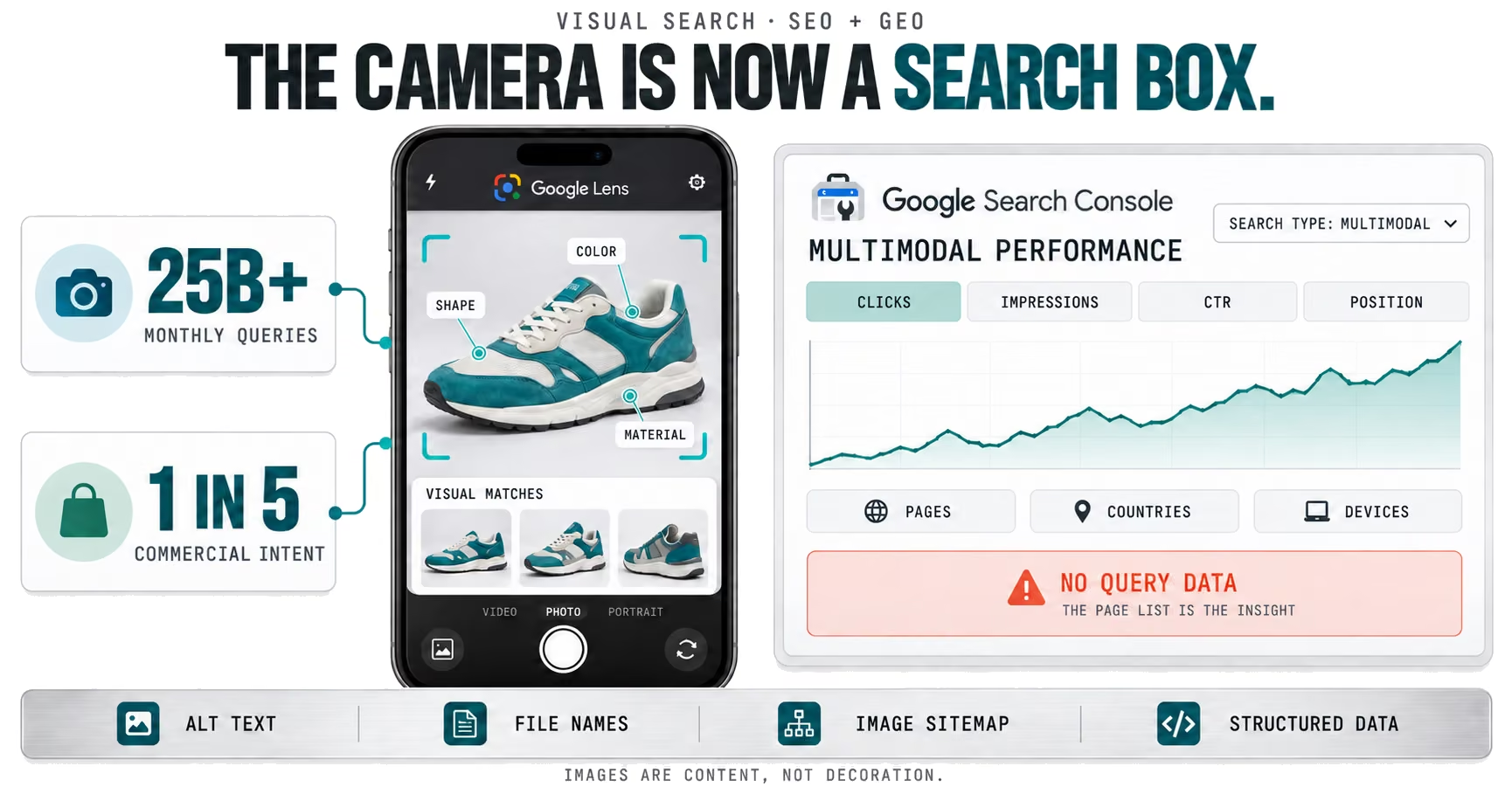
Search stopped being a text box a while ago
We have spent years talking about keywords, rankings, clicks and content. All of that still matters. But the way people start a search has quietly changed, and a lot of teams are going to overlook it.
Google Images itself exists because text was not enough. In its 25th anniversary post in July 2026, Google traced the product back to 2001, when people searching for a famous dress wanted to see it rather than read about it. Twenty five years later, the camera is a search box.
| Year | Visual search step |
|---|---|
| 2001 | Google Images launches |
| 2011 | Search by image |
| 2018 | Lens joins Search |
| 2022 | Multisearch (text plus image) |
| 2024 | Circle to Search |
| 2025 | Lens in AI Mode, Search Live |
| 2026 | Multi-object Circle to Search |
Source for the timeline: Google's 25th anniversary post on Google Images.
The volume is no longer niche. In October 2024, Google reported nearly 20 billion visual searches a month and said younger users aged 18 to 24 engage most with Lens. By December 2025, Google's own marketing research site put the figure at more than 25 billion.
Lens queries are one of the fastest growing types of Search, with more than 25 billion queries per month.
That line comes from Think with Google. If a fraction of your audience searched that way and you had no idea how your site performed for them, you would treat it as a blind spot. Until this week, that is exactly what it was.
What Google just gave you in Search Console
On September 24, Google announced multimodal performance reporting in Search Console. According to Search Engine Journal, the Web search type in the Performance report now splits into text-based traffic and a multimodal option, which Google describes as web results "where an image was used as part of the search."
- Google Lens
- Circle to Search
- Image uploads
- Chrome image search
You get impressions, clicks, click-through rate and average position, broken down by page, country and device. Google's stated goal, as Search Engine Land reported, is to help site owners "better understand your site's performance in the modern search landscape and optimize your visual content." The global rollout started on the day of the announcement, so some properties will see it later than others. We covered the launch alongside the rest of that week's news in our September 21 to 25 roundup.
Before you build a dashboard on it, know what the report cannot tell you.
- There are no queries. Google says specific text query data is not available because multimodal searches mostly use images, so the Queries tab does not appear for this search type.
- You cannot see the image. The report shows which page earned the click, not which photo or object the person searched with.
- History is unclear. Search Engine Journal noted that Google did not say whether data exists before September 24 or whether existing Web totals change retroactively.
- The API lags. At launch, the Search Analytics API documentation had no separate multimodal type, per Search Engine Journal, so export from the report itself for now.
Without queries, the page list is the insight. The pages earning multimodal clicks tell you which images Google already trusts, and the pages that should be earning them and are not become your to-do list. Our guide to building strategy from Search Console data covers how to fold a new report like this into a regular review.
Visual discovery is a buying signal
Visual search is not people idly identifying flowers. The same Think with Google research found that 1 in 5 Lens searches shows commercial intent. Someone photographing a lamp in a hotel lobby or a jacket on the street is often one step from buying it.
Google keeps building for that moment. In February 2026, it upgraded Circle to Search to identify several objects in one image, so a shopper can circle an entire outfit and get results for each piece. Google said Circle to Search now handles billions of queries a month and that shopping is among its top uses.
In AI Mode, the shopping layer is even deeper. Google's September 2025 update added visual results and a "visual search fan-out" technique that looks at secondary objects and subtle details, not just the main subject. Those results draw on a Shopping Graph of more than 50 billion product listings, with more than 2 billion refreshed every hour.
What this means. If your product photography is generic, the same stock shot every competitor uses, or missing from your structured data, visual search has nothing distinctive to match to you. Original images of your actual products, shown from the angles people photograph them in real life, are now a ranking asset.
AI search reads images too
The shift is not limited to Lens. Google said in April 2025 that AI Mode can understand the entire scene in a photo, including how objects relate to each other and their materials, colors, shapes and arrangements.
With Gemini's multimodal capabilities, AI Mode can understand the entire scene in an image, including the context of how objects relate to one another and their unique materials, colors, shapes and arrangements.
AI Mode then uses query fan-out, running multiple searches about the image and the objects in it. One photo becomes several searches, and every one of them is a chance for your page to be cited or skipped. In March 2026, Google expanded Search Live to more than 200 countries and territories, letting people point their camera at something and talk to Search about it in real time.
Visual content is also winning citations in AI answers. Comscore data reported by Search Engine Land found YouTube was the most cited source in AI answers for retail searches in June 2026, at 23%. That is a strong hint that AI systems value content they can see, not only content they can read. For the bigger picture on how discovery now spans many surfaces, see SEO is now a multi-surface system.
The questions every SEO team should be asking
The new report changes the questions worth asking in your next planning meeting.
- Are our images actually discoverable by Google, or hidden in CSS and scripts?
- Are we optimizing images with the same care as our written content?
- Which pages already earn Lens and Circle to Search clicks, and why?
- Do our product photos look like what customers photograph in real life?
- Is anyone on the team checking visual search data every month?
If the honest answer to most of these is "not really," you are in good company. That is also why it is an opportunity. Many competitors will be slow to act on this.
How to make your images discoverable
None of this requires a new playbook. It requires applying the playbook Google already publishes, consistently. Google's image SEO best practices, last updated March 2, 2026, cover most of it.
| Signal | Google guidance | Your move |
|---|---|---|
| HTML element | Use standard img, not CSS backgrounds | Audit templates and sliders |
| Alt text | Descriptive, keywords used naturally | Rewrite generic alt text |
| File names | Short and descriptive | Rename before upload |
| Placement | Near relevant text | Caption key images |
| Sitemaps | Image sitemaps aid discovery | Include CDN image URLs |
| Formats | JPEG, PNG, WebP, SVG, AVIF and more | Serve modern formats |
| Structured data | Image property enables badges | Add image to Product schema |
Two lines in that documentation deserve a place on every developer's wall: "Google doesn't index CSS images," and "Google uses alt text along with computer vision algorithms and the contents of the page to understand the subject matter of the image." If your hero product shot is a CSS background, it does not exist to Google Images.
Google's alt text example is a useful gut check: "Dalmatian puppy playing fetch" beats "puppy," and a list of keywords stuffed into the attribute is worse than both. The same documentation says you can include images hosted on other domains, such as a CDN, in an image sitemap, provided you verify that domain in Search Console.
Two further signals are easy wins. The image metadata structured data guide explains how to add creator, credit and license details, which can earn a Licensable badge in Google Images and travels with the file when you use IPTC metadata. And the image SEO guide notes that the primaryImageOfPage property, the image property on the main entity, and the og:image tag all influence which image represents your page.
Actions worth taking now
- Open the multimodal filter as soon as it appears. In the Performance report, switch the Web search type to multimodal, export the page list, and record a baseline.
- Compare it against text traffic. Pages with a high share of multimodal clicks tell you which images Google already trusts; build more pages like them.
- Audit your top 20 product and service pages. Check for real img elements, descriptive alt text, sensible file names and captions near each key image.
- Replace stock with originals where it matters. Shoot the products people actually photograph, from the angles they photograph them.
- Fix the structured data. Add image properties to Product and Article markup, and add image license metadata if you publish original photography.
- Submit or update your image sitemap. Include CDN-hosted images and verify the CDN domain in Search Console.
The fundamentals of SEO have not changed, but the front door has. When more than 25 billion searches a month can start with a camera, images stop being decoration and start being content. Treat them that way now, while most of your competitors are still only reading their keyword reports.
Frequently Asked Questions
Common questions about GEO, SEO, and AI-driven search visibility.
The multimodal filter is a search type in the Search Console Performance report that Google began rolling out globally on September 24, 2026. It shows clicks, impressions, click-through rate and position for web results where an image was part of the search, including Google Lens, Circle to Search on Android, image uploads to Google Search and Chrome's search this image option, according to Search Engine Journal. It sits under the Web search type, split from text-based traffic.
No. Google says that because multimodal searches mostly use images rather than text, specific text query data is not available for this traffic, so the Queries tab does not appear for the multimodal search type. Search Engine Journal reported that you can see pages, countries and devices, but not which image triggered the search.
Google said in December 2025, on its Think with Google site, that Lens handles more than 25 billion queries per month and is one of the fastest growing types of Search. The same Google page said 1 in 5 Lens searches shows commercial intent. That is up from the nearly 20 billion monthly visual searches Google reported in October 2024.
Follow Google's image SEO best practices: use standard HTML img elements rather than CSS backgrounds, write descriptive alt text, use descriptive file names, place images near relevant text, and submit an image sitemap. Google's documentation also recommends structured data with an image property, and supports formats including JPEG, PNG, WebP, SVG and AVIF. Original, high quality product photos give visual search more to match against than stock images.
Yes. Google's image SEO documentation, last updated March 2, 2026, says Google uses alt text along with computer vision and page content to understand images, and recommends information-rich alt text that uses keywords appropriately without stuffing. Its example of good alt text is Dalmatian puppy playing fetch rather than just puppy.
Yes. Google said in April 2025 that AI Mode can understand an entire scene in an image, including how objects relate and their materials, colors and shapes, and uses query fan-out to run multiple searches about the image and the objects in it. In September 2025 Google added visual results to AI Mode, backed by a Shopping Graph of more than 50 billion product listings.
Sources
- Think with Google: Top search trends and marketing takeaways (opens in a new tab)
- Google Blog: Google Images, 25 years of visual search innovation (opens in a new tab)
- Google Blog: Google updates, AI-Organized Search, Google Lens, and more (opens in a new tab)
- Google Search Central Blog: Announcing web multimodal Search performance reporting in Search Console (opens in a new tab)
- Search Engine Journal: Google Search Console Adds Multimodal Filter For Image-Based Searches (opens in a new tab)
- Search Engine Land: Google Search Console performance reports gets multimodal filter (opens in a new tab)
- Google Blog: Circle to Search gets updated to search multiple things at once (opens in a new tab)
- Google Blog: AI Mode in Google Search adds multimodal search (opens in a new tab)
- Google Blog: AI Mode in Google Search updates, visual exploration and discovery (opens in a new tab)
- Google Blog: Google Search Live expands globally (opens in a new tab)
- Search Engine Land: Google AI Overviews now appear in 39% of U.S. desktop searches (opens in a new tab)
- Google Search Central: Google image SEO best practices (opens in a new tab)
- Google Search Central: Image metadata in Google Images (opens in a new tab)