




Why I Still Want a Person Writing the Content
 Preferred source
I use AI every day, and that is not the question
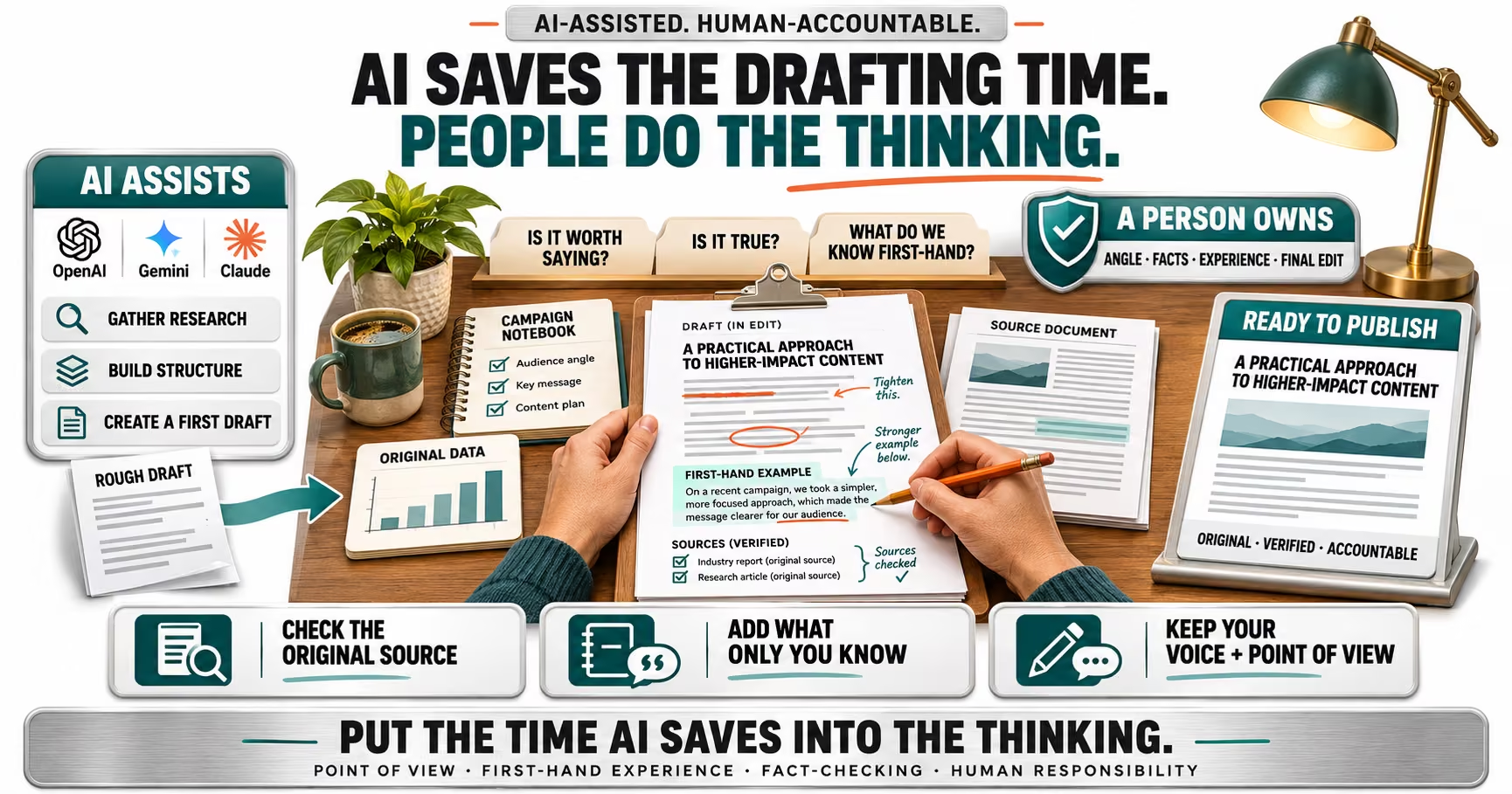
I want to be clear about where I stand, because this is not an anti-AI post. I use AI to gather research, sort notes into an outline, suggest structures and get a rough first draft on the page. Google's own guidance on generative AI content describes that use well: it says generative AI "can be particularly useful when researching a topic, and to add structure to original content."
The productivity evidence is strong. In a preregistered experiment by MIT economists Shakked Noy and Whitney Zhang, 444 college-educated professionals wrote the kinds of documents they write at work: press releases, short reports, delicate emails. Those given ChatGPT finished 10 minutes faster, a 37% drop, and their work was graded higher.
So the question is not whether to use AI. It is which parts of the job it should do, and which parts it should never be trusted to do alone.
The speed is real, and so is the edge
The best study I know on that question comes from Harvard Business School and Boston Consulting Group. Researchers gave 758 BCG consultants realistic consulting tasks, some with GPT-4 and some without. On tasks inside what the AI could do well, the results were striking, according to the working paper.
they completed 12.2% more tasks on average, and completed task 25.1% more quickly
Quality rose by more than 40%. Then the researchers gave one task that sat just outside the AI's abilities, one that looked similar but needed judgment the model did not have. There, consultants using AI were 19 percentage points less likely to produce a correct answer than those working without it.
The authors called this a jagged frontier, and I think it is the most useful idea in the whole AI debate. The problem is not that AI is bad at the work. The problem is that from inside a fluent draft, you cannot see where the frontier is. Knowing which side of that line a piece of content sits on is a judgment call, and it belongs to the person who knows the subject.
| Task | Who leads | Why |
|---|---|---|
| Research gathering | AI, then person | Fast, but sources need checking |
| Outline and structure | AI | Pattern work it does well |
| First draft | AI | Gets words on the page |
| Angle and argument | Person | Needs a point of view |
| Facts and figures | Person | Models predict, not verify |
| Examples and stories | Person | Only real if you were there |
| Final edit | Person | Voice, clarity, accountability |
Someone has to decide what is worth saying
Every useful piece of content starts with a decision about what is worth saying. That decision rarely comes from a prompt. It comes from the campaign that underperformed and the reason we found, the question a client asked twice, the thing we tried that the textbooks said would work and did not.
Google asks for exactly this. Its guidance on creating helpful, reliable, people-first content includes a question I treat as a writing test: does your content "clearly demonstrate first-hand expertise and a depth of knowledge"? The same page says that of the parts of E-E-A-T, "trust is most important," and it lists "Are you using extensive automation to produce content on many topics?" as a warning sign. We have written more about why E-E-A-T matters more in AI search.
A language model can describe an experience. It cannot have one. It has not run your campaign, sat in your client meeting or watched your numbers change after a site migration. When a draft needs a real example, the model will offer a plausible one, and plausible is the problem. If nobody on the team has done the work, there is nothing true to add, and the reader can usually tell.
Someone has to decide whether it is true
The second decision is whether what we are saying is true, and this is where unedited AI content fails most often.
OpenAI has been candid about why. Its September 2025 research summary, Why language models hallucinate, says that "standard training and evaluation procedures reward guessing over acknowledging uncertainty." Google's generative AI guidance puts it just as plainly: generative models "don't retrieve facts, but predict a likely sequence of words," and "it is critical to manually factcheck and review all AI-generated content" before publishing. That review covers the metadata too: titles, meta descriptions, structured data and alt text.
Independent testing shows the size of the gap.
- In a study coordinated by the European Broadcasting Union, journalists from 22 public service broadcasters in 18 countries reviewed more than 3,000 answers from ChatGPT, Copilot, Gemini and Perplexity. They found 45% had at least one significant issue, 31% had serious sourcing problems and 20% had major accuracy issues.
- Columbia's Tow Center tested eight AI search tools on 1,600 queries and found they answered more than 60% incorrectly when asked to identify a news article's source. The researchers noted the tools gave wrong answers "with alarming confidence, rarely using qualifying phrases."
Readers sense this. A Pew Research Center survey of 5,410 U.S. adults found 66% are highly concerned about people getting inaccurate information from AI, and 70% of the AI experts Pew surveyed said the same. When a business publishes something wrong, the business owns the mistake, not the tool.
In practice, I check every statistic against the original source, not against the summary the model gave me. I open every link. If I cannot find where a number came from, it does not go in.
Thinking is the part I refuse to outsource
There is a quieter reason I keep a person in the chair. Writing is how I find out what I think, and I have noticed that when the draft arrives too easily, the thinking can arrive less.
The research on this is early, but it points the same way.
- A Microsoft Research and Carnegie Mellon survey of 319 knowledge workers, presented at CHI 2025, found that "higher confidence in GenAI is associated with less critical thinking," while higher self-confidence was associated with more.
- An EEG study by Nataliya Kosmyna and colleagues, Your Brain on ChatGPT, followed 54 people writing essays with an LLM, a search engine or nothing. The authors report that over four months, "LLM users consistently underperformed at neural, linguistic, and behavioral levels."
- In a Science Advances study by Anil Doshi and Oliver Hauser, stories written with AI-generated ideas were rated more creative and better written, but they were also "more similar to each other than stories by humans alone."
- Most of this is self-reported or small. The Microsoft study is a survey of how people describe their own work, not a measure of output quality.
- The EEG study is a preprint. Its arXiv listing shows no journal publication, and only 18 of the 54 participants completed the final session.
- Similar is not the same as worse. Doshi and Hauser found individual stories improved; the cost was in collective variety.
That last finding is the one I think about most for content marketing. If every company in a category drafts with the same handful of models, the drafts start to sound alike. The only way out of that sameness is to add something the model could not have produced: your data, your example, your opinion.
Search and AI answers reward the same thing
None of this is about avoiding a penalty. Google does not punish content for being AI-assisted, as we explained in does Google penalize AI content. Its spam policies target scaled content abuse, defined as "many pages are generated for the primary purpose of manipulating search rankings and not helping users," and the policy applies "no matter how it's created." One of its examples is using generative AI tools "to generate many pages without adding value for users."
The bigger risk is commercial. When AI summaries answer the question on the results page, content that only restates what is already known gets summarized and skipped. Pew's browsing study found Google users clicked a traditional result in 8% of visits when an AI summary appeared, against 15% when it did not, and clicked a link inside the summary in just 1% of visits. Generic content is the easiest kind to summarize. Original findings, first-hand examples and clear opinions are what give a reader, or an AI answer, a reason to cite you.
There is a legal angle too. The U.S. Copyright Office's January 2025 report concluded that "prompts do not alone provide sufficient control" and that "copyright does not extend to purely AI-generated material." Human authors keep rights in their own expression and in the creative selection and arrangement of AI output. If content is a business asset, the human contribution is part of what makes it yours.
How we put this into practice
- Start every brief with what we know. Before any prompt, write down the experience, data or opinion that only our team can bring. If that list is empty, the piece is not ready.
- Let AI draft, then rewrite the argument. Use the draft for structure and coverage, and make sure the angle, examples and conclusions come from a person.
- Verify every claim at the source. Open each link, find each figure in the original document, and cut anything that cannot be traced.
- Check the metadata as closely as the copy. Google's guidance covers titles, descriptions, structured data and alt text, so review those before publishing.
- Put a real name on the byline. Use an author with a profile that shows why they are qualified, and never invented names or credentials.
- Spend the saved time on thinking. Use the hours AI frees up for interviews, original data and better editing rather than more volume.
AI has made the typing cheap. It has not made judgment cheap, and judgment is what readers, search engines and AI answers are all trying to find. I will keep using AI to get to the first draft faster, and I will keep a person responsible for what we say and whether it is true.
Frequently Asked Questions
Common questions about GEO, SEO, and AI-driven search visibility.
Not for being AI-generated. Google's helpful content guidance says to evaluate content by Who, How and Why, and its spam policies define scaled content abuse as many pages generated mainly to manipulate rankings, no matter how they are created. Using generative AI to produce many pages without adding value for users can violate that policy.
In an MIT experiment with 444 college-educated professionals by Shakked Noy and Whitney Zhang, ChatGPT cut time on writing tasks by 10 minutes, or 37%, and raised quality grades. A Harvard Business School study of 758 BCG consultants found AI users completed tasks 25.1% faster on work inside the AI's abilities.
Not accurate enough to publish unchecked. An October 2025 study coordinated by the European Broadcasting Union found 45% of more than 3,000 AI assistant answers about the news had at least one significant issue, and 20% had major accuracy problems. Columbia's Tow Center found eight AI search tools answered more than 60% of its citation queries incorrectly.
OpenAI's September 2025 research summary says standard training and evaluation procedures reward guessing over acknowledging uncertainty. Google's guidance on generative AI content adds that generative models do not retrieve facts but predict a likely sequence of words, so every AI-generated claim needs a manual fact-check.
Early evidence points that way. A Microsoft Research and Carnegie Mellon survey of 319 knowledge workers, presented at CHI 2025, found higher confidence in generative AI was associated with less critical thinking. An EEG study of 54 participants by Nataliya Kosmyna and colleagues found weaker brain connectivity among ChatGPT users, though it is a preprint with a small sample.
Not purely AI-generated material. The U.S. Copyright Office's January 2025 report concluded that prompts alone do not provide sufficient control, while human authors keep copyright in their own expression and in the creative selection, coordination or arrangement of material in AI outputs.
Sources
- Google Search Central: Google Search's guidance on generative AI content on your website (opens in a new tab)
- MIT: Experimental evidence on the productivity effects of generative artificial intelligence (opens in a new tab)
- SSRN: Navigating the Jagged Technological Frontier, field experimental evidence of the effects of AI on knowledge worker productivity and quality (opens in a new tab)
- Google Search Central: Creating helpful, reliable, people-first content (opens in a new tab)
- OpenAI: Why language models hallucinate (opens in a new tab)
- European Broadcasting Union: Largest study of its kind shows AI assistants misrepresent news content 45% of the time (opens in a new tab)
- Columbia Journalism Review: AI Search Has a Citation Problem (opens in a new tab)
- Pew Research Center: How the U.S. public and AI experts view artificial intelligence (opens in a new tab)
- Microsoft Research: The impact of generative AI on critical thinking (opens in a new tab)
- arXiv: Your Brain on ChatGPT, accumulation of cognitive debt when using an AI assistant for essay writing task (opens in a new tab)
- Science Advances: Generative AI enhances individual creativity but reduces the collective diversity of novel content (opens in a new tab)
- Google Search Central: Spam policies for Google web search (opens in a new tab)
- Pew Research Center: Google users are less likely to click on links when an AI summary appears in the results (opens in a new tab)
- U.S. Copyright Office: Copyright and Artificial Intelligence, Part 2, Copyrightability (opens in a new tab)