





One Question, Ten Searches: Why AI Just Made SEO More Important
 Preferred source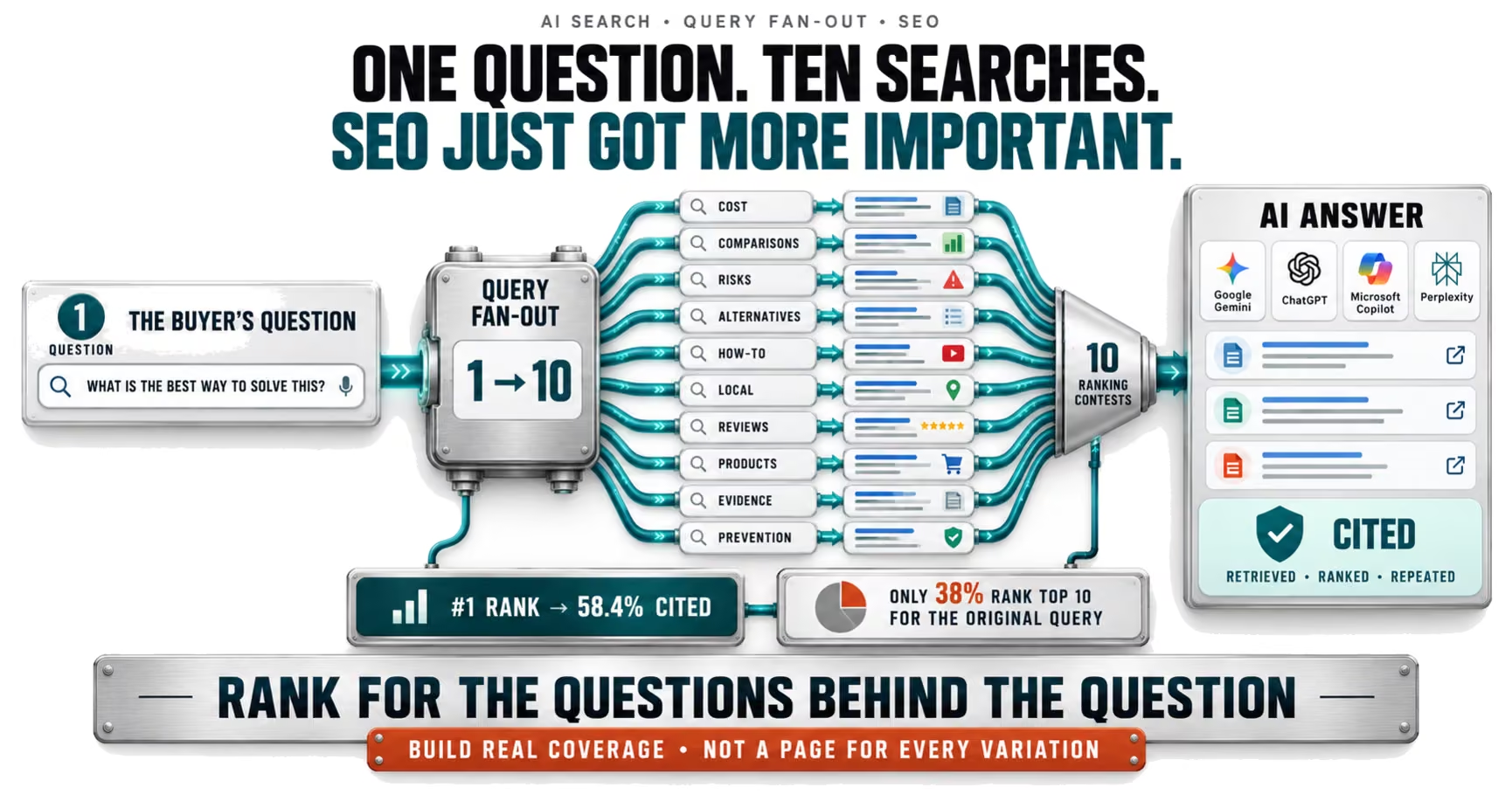
A question worth taking seriously
A version of this question has been circulating among search marketers: since LLMs construct multiple fan-out queries and use search engines to run them simultaneously, doesn't that imply SEO is actually more important than it was before? Better coverage should lead to better visibility.
It is a sharper question than most of the "SEO is dead" debate, because it starts from how these systems actually work. An AI answer engine that runs ten searches behind the scenes is not replacing search. It is consuming search results at a scale no human ever did. If you do not appear in those results, the model cannot cite you, however good your content is.
The short answer is yes. The longer answer is that "more important" comes with a change in what you are optimizing for, three important exceptions, and one clear warning from Google. This article walks through all of it so you can decide how to act on it.
What query fan-out actually is
Google introduced the term publicly when it launched AI Mode. Its May 2025 announcement described the query fan-out technique as "breaking down your question into subtopics and issuing a multitude of queries simultaneously on your behalf," and said its Deep Search mode "can issue hundreds of searches" to build a single cited report.
Google's 2026 guide to optimizing for generative AI features gives the clearest definition and a useful example.
For example, if the original user's query is 'how to fix a lawn that's full of weeds', fanout queries might include 'best herbicides for lawns', 'remove weeds without chemicals', and 'how to prevent weeds in lawn'.
Notice what happened there. A homeowner typed one question. Google went looking for three different kinds of page: product comparisons, organic methods and prevention guides. A garden center that ranks well for only one of those has a third of the chance of being in the answer.
Other engines do the same thing with different machinery. OpenAI's help page on ChatGPT search says it "typically rewrites your query into one or more targeted queries" sent to search providers, and that "after reviewing the initial results, ChatGPT search may send additional, more specific queries." Microsoft even names the concept in its tools: Bing's AI Performance report shows "grounding queries," the phrases AI used when retrieving your content.
| Engine | How it searches | Whose index |
|---|---|---|
| Google AI Overviews, AI Mode | Fan-out across Google Search | |
| ChatGPT search | Rewrites into targeted queries | Third-party providers |
| Microsoft Copilot | Grounding queries | Bing |
| Claude | Web search tool | Brave, per reporting |
| Perplexity | Sub-document retrieval | Its own index |
Sources for the table: Google, OpenAI, Bing, TechCrunch on Claude and Brave and Perplexity. The Claude entry is based on 2025 reporting that Anthropic added Brave Search to its subprocessor list; Anthropic has not published a detailed description of its search stack.
The evidence that rankings feed the answer
If fan-out were a sideshow, rankings would not predict citations. They do. AirOps analyzed 16,851 queries run three times each in ChatGPT, and Search Engine Land reported that pages in the top search position were cited 58.4% of the time, falling to 14.2% at position 10. AirOps sells AI content software and scraped the ChatGPT interface rather than the API, so treat the exact figures as directional, but the slope is steep.
Google says the same thing in plainer words. Its AI features "rely on AI techniques to highlight content from our Search index" and are "rooted in our core Search ranking and quality systems," according to its optimization guide, which concludes that optimizing for generative AI search "is optimizing for the search experience, and thus still SEO."
Microsoft goes a step further and describes an index built for answers. In a May 2026 post, Bing said the unit of value is now "discrete, supportable facts with clear provenance," and that "a stale fact produces a misleading response." Retrieval is still the gate, but what passes through it is judged on evidence as well as relevance.
The research community lands in the same place. A July 2026 critical survey of GEO research found query-document relevance and position in the model's context are "the two most robust factors" in whether a source gets used. Both are downstream of retrieval, which is downstream of search.
And the scale is enormous. Google said in its Q2 2026 earnings remarks that AI Mode has reached 1 billion monthly active users. If each of those sessions fans out into several searches, the total number of ranking contests your pages enter every day has multiplied, not shrunk.
The catch: rank for the questions behind the question
Here is where the premise needs refining. If rankings simply transferred, AI Overview citations would come from the top 10 for the query the user typed. Increasingly they do not.
Ahrefs examined 863,000 keywords and 4 million AI Overview URLs, and Search Engine Journal reported that only 38% of cited pages ranked in the top 10 for the original query in March 2026, down from 76% in July 2025. The explanation offered was fan-out.
Google can split the original query into multiple related sub-queries. The pages that appear most often across those sub-query results then get cited in the AI Overview.
Ahrefs noted that improved measurement may explain part of the drop, and Google has not confirmed specific changes. But the implication is powerful: you can be cited for "how to fix a lawn full of weeds" without ranking for it at all, if you rank well for "remove weeds without chemicals." And you can rank first for the head term and still be left out.
The AirOps data adds a twist that surprises people who assume "coverage" means longer pages. According to Search Engine Land's summary, narrowly focused pages outperformed comprehensive guides, pages of 500 to 2,000 words performed best, and pages with the strongest heading-to-query match were cited 41% of the time versus about 30% for weak matches. Fan-out rewards pages that answer a specific sub-question cleanly.
Perplexity's architecture points the same way. The company says its index "divides documents up into fine-grained units" that are "individually surfaced and scored" against the query. In retrieval terms, a well-labeled section of a page can compete on its own.
| Old SEO unit | Fan-out SEO unit |
|---|---|
| One head keyword | The cluster of sub-questions |
| Ranking position | Retrievability across sub-queries |
| The ultimate guide | Focused pages and sections |
| Page-level relevance | Passage-level answers |
| One language market | Sub-queries may switch language |
That last row deserves a note. Peec AI analyzed 20 million fan-out queries, and Search Engine Journal reported that 43% of ChatGPT's fan-out queries for non-English prompts ran in English, with 78% of non-English prompt runs including at least one English sub-query. Peec sells AI visibility tracking and the sample came from its own platform, but for international brands the implication is real: your English-language pages may be competing for answers in markets you thought were local.
What coverage means, and what Google says it does not
The tempting conclusion is to publish a page for every fan-out query you can find. Google anticipated that.
While it might be tempting to create separate content for every possible variation of how people might search (for example, by focusing on other queries that people have asked, or fan-out queries), doing so primarily to manipulate rankings or generative AI responses in Google Search violates Google's scaled content abuse spam policy.
That line is from Google's optimization guide, and it draws the boundary clearly. Coverage is good when it serves the person asking. It becomes spam when it exists to catch variations.
| Genuine coverage | Scaled content abuse |
|---|---|
| A section answering each real sub-question | A page per phrasing of the same question |
| Distinct pages for distinct needs | Near-duplicate pages for keyword variants |
| First-hand evidence and examples | Rewritten summaries of other pages |
| Updated when facts change | Mass-produced and never revisited |
A useful test: would you build this page if AI search did not exist, because your customers ask this? If yes, it is coverage. If the only reason is to intercept a sub-query, reconsider.
Where "SEO is more important" breaks down
The premise is mostly right. It is not entirely right, and the exceptions matter when you are deciding where to spend.
- Not every citation comes from ranking. In the Ahrefs data, YouTube made up 18.2% of citations to pages ranking outside the top 100, which points to sources the engines value beyond classic organic results.
- Reputation matters beside rankings. Across 75,000 brands, Ahrefs found YouTube mentions and branded web mentions correlated far more strongly with AI brand visibility than backlinks or domain rating.
- Each engine searches a different index. Ranking in Google helps AI Overviews; it does not guarantee visibility in engines that use Bing, Brave or their own index.
- Citations are not clicks. Pew Research found people clicked a link inside an AI summary in just 1% of visits, so more retrieval does not automatically mean more traffic.
- Answers are volatile. SparkToro and Gumshoe found less than a 1% chance that AI tools returned the same brand list twice, because fan-out itself varies run to run.
So the honest framing is this: SEO is more important as the retrieval layer, the thing that gets you into the room. Whether you are chosen once you are in the room depends on evidence, freshness and reputation too. We explored that second layer in why AI visibility is built on SEO and the broader shift in rank, answer, cite.
How to see your fan-out footprint
You cannot optimize what you cannot see, and fan-out mostly happens out of view. Here is what is measurable today.
Bing is the most transparent. Its AI Performance report shows the grounding queries behind your citations, which are effectively the fan-out queries Copilot ran, and since June 2026 it adds Citation Share, "the percentage of citations attributed to your site out of all citations shown across all sites for that same grounding query." If you only look at one report this quarter, make it this one.
Google Search Console's generative AI report shows impressions in AI Overviews and AI Mode by page, country and device, but not clicks or the sub-queries behind them. Use it to see which pages are being retrieved, then infer the fan-out from what those pages answer.
For everything else, reconstruct the fan-out yourself. Ask the engines your buyers use a representative question, look at the sources cited, and work out which sub-question each source answered. Repeat it several times, because answers vary, and look for patterns rather than single results.
- For our most valuable topic, what are the five to ten sub-questions an AI would search?
- Which of those sub-questions do we rank for today, and which do competitors own?
- Do our pages answer each sub-question in a clearly headed, self-contained section?
- Which grounding queries does Bing show for our cited pages?
- Are any of our key facts stale enough to be skipped?
How to rebuild keyword research for fan-out
Traditional keyword research asks what people type. Fan-out research asks what an AI will search on their behalf. The process is similar; the unit is different.
- Start with the buyer question, not the keyword. Write the full, conversational question a customer would ask an assistant.
- Decompose it. List the sub-questions an expert would need to answer it fully: comparisons, costs, risks, alternatives, how-to steps, local options.
- Validate with real data. Check Bing grounding queries, the sources AI engines cite for the question, and your own search query data for each sub-question.
- Map each sub-question to one owner. Decide which existing page or section answers it best, so you are not creating competing pages.
- Close the gaps with substance. Add sections or new pages only where a real sub-question has no good answer on your site, with first-hand evidence where you have it.
- Make each answer retrievable. Clear headings that match the sub-question, the answer early in the section, facts in the HTML rather than behind scripts, and dates that show freshness.
This is the same discipline good SEO always required, applied to a finer grain. Google's own AI search optimization guidance is a good companion read.
What to do this quarter
- Pick your ten money questions. Choose the questions that lead buyers to you and decompose each into its likely fan-out sub-queries.
- Audit sub-query rankings, not just head terms. Track where you rank for each sub-question in Google and Bing, since different engines search different indexes.
- Open Bing Webmaster Tools. Review grounding queries and Citation Share for your most cited pages, and add missing sub-questions to your map.
- Restructure for passages. Give each real sub-question its own clearly headed section with the answer up front.
- Prefer focused pages over mega-guides. Split sprawling guides where sections serve different needs, and merge thin near-duplicates.
- Stay on the right side of Google's line. Build coverage for people, never a page per phrasing, and keep facts current.
- Invest in reputation alongside rankings. Earn mentions on the platforms engines cite, especially video and trusted publications.
The instinct behind the original question is right. AI did not make search engines obsolete; it made them the plumbing of every answer, running more searches than any person ever would. The brands that win will be the ones that show up across all of those searches, with answers worth repeating.
Frequently Asked Questions
Common questions about GEO, SEO, and AI-driven search visibility.
Query fan-out is when an AI search system turns one question into several related searches and runs them at the same time. Google's 2026 documentation defines fan-out queries as a set of concurrent, related queries generated by the model to fetch additional relevant search results, and gives the example of 'how to fix a lawn that's full of weeds' fanning out to queries like 'best herbicides for lawns' and 'remove weeds without chemicals'.
Largely yes, because fan-out runs real searches and the results feed the answer. Google says its generative AI features are rooted in its core Search ranking and quality systems, and AirOps data reported by Search Engine Land in April 2026 found ChatGPT cited pages in the top search position 58.4% of the time versus 14.2% at position 10. The difference is that you need to rank for the sub-questions, not just the head keyword.
Query fan-out is a major reason. Ahrefs data reported by Search Engine Journal in March 2026 found only 38% of AI Overview citations ranked in the top 10 for the original query, and the analysis suggested cited pages often rank for the related sub-queries Google generates instead. YouTube also made up 18.2% of citations to pages ranking outside the top 100.
No. Google's AI optimization guide says creating separate content for every variation people might search, including fan-out queries, primarily to manipulate rankings or generative AI responses violates its scaled content abuse spam policy. Cover the real sub-questions your buyers have within well-organized, useful pages instead.
They differ. OpenAI says ChatGPT search rewrites queries and sends them to third-party search providers, TechCrunch reported in March 2025 that Claude's web search appears to use Brave Search, and Perplexity says its Search API draws on its own index covering hundreds of billions of webpages. Google's AI features use Google's own Search index, and Microsoft Copilot grounds answers in Bing.
Bing Webmaster Tools is the most direct source today. Its AI Performance report, launched in February 2026, shows the grounding queries AI used when retrieving your content, and in June 2026 Bing added Citation Share by query. Google Search Console's generative AI report shows AI Overview and AI Mode impressions by page but not the underlying queries.
Sources
- Google Search Central: Optimizing your website for generative AI features on Google Search (opens in a new tab)
- Google Blog: AI Mode in Google Search, updates from Google I/O 2025 (opens in a new tab)
- OpenAI Help Center: ChatGPT search (opens in a new tab)
- Bing Webmaster Blog: Introducing AI Performance in Bing Webmaster Tools public preview (opens in a new tab)
- Bing Search Blog: Evolving role of the index, from ranking pages to supporting answers (opens in a new tab)
- Bing Search Blog: New AI visibility insights in Bing Webmaster Tools (opens in a new tab)
- Perplexity: Introducing the Perplexity Search API (opens in a new tab)
- TechCrunch: Anthropic appears to be using Brave to power web searches for its Claude chatbot (opens in a new tab)
- Search Engine Land: ChatGPT citations study on ranking, precision and length (opens in a new tab)
- Search Engine Journal: Google AI Overview citations from top-ranking pages drop sharply (opens in a new tab)
- Search Engine Journal: ChatGPT search often switches to English in fan-out queries (opens in a new tab)
- The Next Web: YouTube mentions are the top signal for AI brand visibility (opens in a new tab)
- Pew Research Center: Google users are less likely to click on links when an AI summary appears in the results (opens in a new tab)
- Search Engine Journal: AI recommendations change with nearly every query, SparkToro (opens in a new tab)
- arXiv: Optimizing visibility in generative engines, a critical survey of GEO 2023 to 2026 (opens in a new tab)
- Search Engine Land: Google Search Console AI performance reports and Search generative AI control rolling out globally (opens in a new tab)
- Google Blog: Alphabet earnings call Q2 2026, Sundar Pichai remarks (opens in a new tab)