





Five Layers of SEO. One Percent of the Traffic.
 Preferred source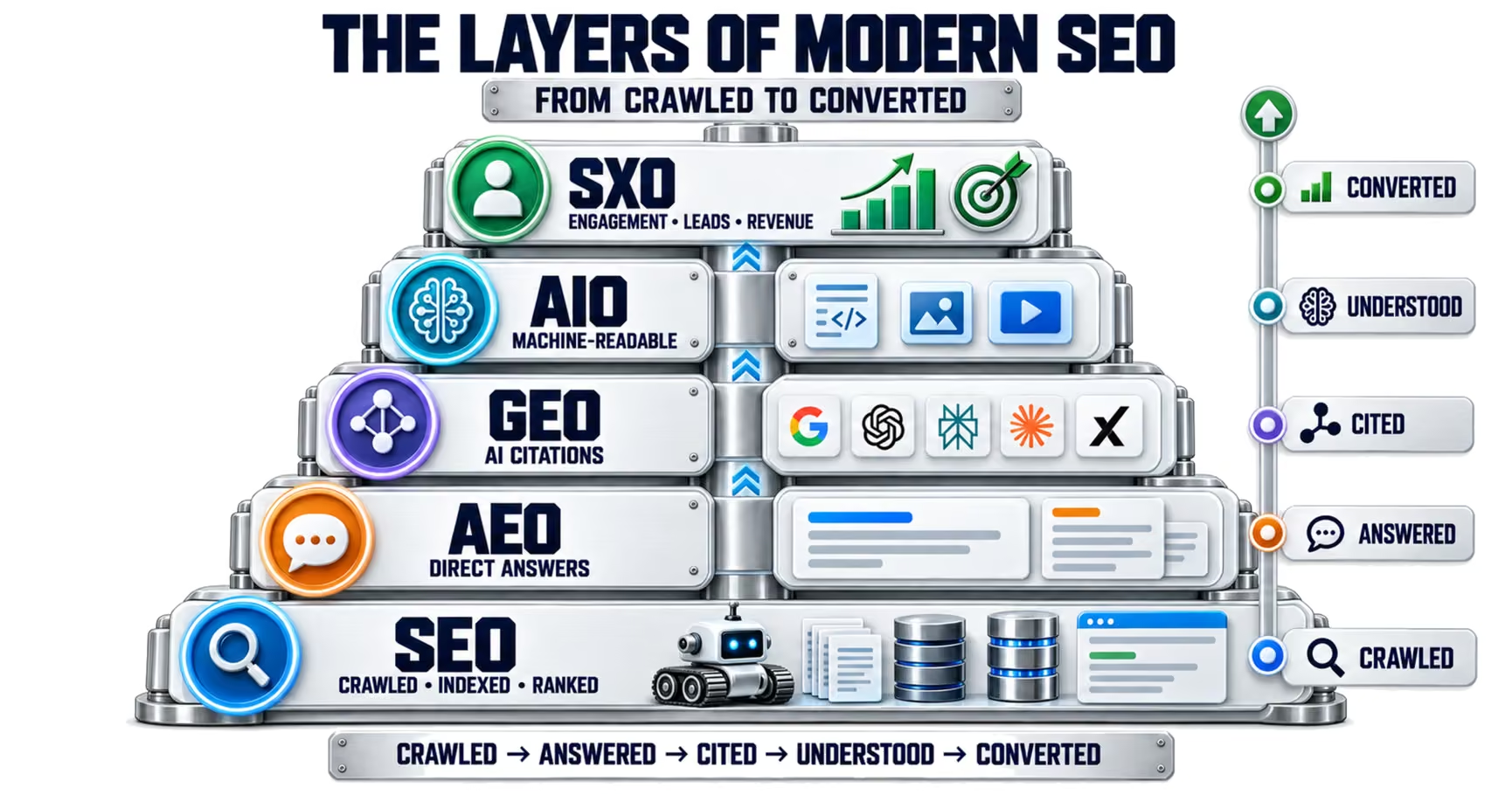
The diagram is right about the work
Let me be fair to it first, because the framework is useful and I would rather improve it than dunk on it.
It captures something real. There are now multiple distinct surfaces where a brand can be visible, they have different mechanics, and they are measured in different places. A team that thinks only about blue-link rankings in 2026 is missing most of the board. Laying that out as layers, each with a goal, a focus and a success metric, is a clearer teaching tool than most of what the industry produces.
The problem is not the layers. It is the equal signs between them, and the implication that each one is a separate practice needing its own budget line, its own specialist and its own retainer.
That implication is where clients lose money. So let us take the layers one at a time and check each against what the platforms and the published data actually say.
| Layer | What it claims to be | Verdict | Where it is measured |
|---|---|---|---|
| SEO | The first of five equal bands | Not a layer. It is the floor every other layer stands on | Search Console, analytics |
| AEO | Being the answer, not one result in a list | Real, and twenty years old | Answer feature appearances, branded search lift |
| GEO | Being cited inside AI-generated responses | Real. Google says it is still SEO; Bing built tooling for it | Search Console AI report, Bing Webmaster Tools |
| AIO | Making content machine readable | Does not survive. Mostly GEO renamed, partly contradicted by Google | No instrument exists |
| SXO | Converting the visitor once they arrive | Most durable layer, but the revenue claim is contested | Your own analytics |
Layer one: SEO is not a layer, it is the floor
The diagram puts SEO at the top as the first of five. In practice it is underneath all four of the others, and Google states the dependency explicitly.
To appear in Google's generative AI features, a page must be indexed and eligible to be shown with a snippet, meeting the standard Search technical requirements, and the site must not have opted out of AI features. That is not a philosophical point about foundations. It is a hard gate. A page that fails technical SEO cannot be an answer, cannot be cited, and cannot convert anyone, because it will not be retrieved in the first place.
Google explains the retrieval mechanics in the same document. Its AI features run on retrieval-augmented generation, also called grounding, which "relies on our core Search ranking systems to retrieve relevant, up-to-date web pages from our Search index," plus query fan-out, where the model issues several related queries to gather more results.
Read that sentence twice if you sell GEO services. The generative layer does not have its own index, its own crawler or its own ranking logic on Google. It reaches into the same index your technical SEO work feeds. Which means the single highest-leverage action for AI visibility on Google is the least glamorous one available: make sure your important pages are crawlable, indexed and not accidentally excluded. Our technical SEO checklist covers exactly that ground.
What this means for the diagram. Redraw it. SEO is not the first of five bands. It is the slab the other four sit on. Every dollar spent on the upper layers is contingent on it, and no amount of AI-specific tactics compensates for a page that is not indexed.
Layer two: AEO is real, and it is twenty years old
Answer engine optimization is a genuine discipline, and it long predates the acronym. Its lineage runs through featured snippets, the position-zero chase and voice search. The unit of success shifts from being one result in a list to being the answer.
The data supports treating this as important. SparkToro research using Similarweb clickstream data, reported by Search Engine Land, found US Google searches ended without a click 68.01 percent of the time in the first four months of 2026, up from 60.45 percent in 2024. Worth carrying the caveat: that count includes clicks to Google-owned properties like Maps and YouTube but excludes follow-up searches, and SparkToro notes its data providers have changed over the years, so the long-term line is not a like-for-like comparison.
Still, roughly two thirds of searches ending without a click is the strongest argument in the whole framework for optimizing to be the answer rather than merely a result.
The intent mix is shifting underneath that number too. Search Engine Journal's review of two studies on how AI is reshaping search intent is worth reading alongside the zero-click figure, because the queries that survive as clicks are not a random sample of the queries that used to. Informational lookups are the ones being absorbed. Commercial and navigational intent is holding up better. That distinction matters far more for planning than the headline percentage, and almost nobody segments for it.
What this means for the diagram. AEO earns its place, with one correction. The diagram lists "zero-click visibility" as a success metric. Zero-click is a state of the market, not something you can raise or lower. Measure appearances in answer features and branded search lift instead, which are things your work can actually move.
Layer three: GEO is real, and Google says it is still SEO
Generative engine optimization has a precise origin. It comes from a 2023 paper by Aggarwal, Murahari, Rajpurohit, Kalyan, Narasimhan and Deshpande, later accepted to KDD 2024, which framed the problem honestly and reported that its methods could boost visibility by up to 40 percent. That figure is an upper bound measured on a purpose-built benchmark, not an average on live Google, and the authors themselves noted efficacy varies by domain. If you want the fuller background, start with what GEO actually is.
Here is where the naming gets interesting, because the two biggest players disagree in public.
From Google Search's perspective, optimizing for generative AI search is optimizing for the search experience, and thus still SEO.
That is Google's guide addressing the acronyms by name. Microsoft went the other way, launching AI Performance in Bing Webmaster Tools in February 2026 and describing it as "an early step toward Generative Engine Optimization (GEO) tooling."
Both are telling the truth about their own systems, which is why the taxonomy argument never resolves. I worked through that tension at length in our piece on AEO versus GEO versus SEO.
What this means for the diagram. Keep the layer, drop the idea that it is a separate budget. The measurement is separate, because Google's generative AI performance report gives impressions without clicks or queries while Bing's gives citations with sampled grounding queries. The work underneath is the same work.
Layer four: AIO is the one that does not survive
This is the layer I would delete.
As usually described, AI optimization means making content machine readable: semantic entities, Knowledge Graph signals, structured data, consistent brand information, multimedia, freshness. Compare that against GEO in the layer above and the overlap is close to total. Two labels, one activity.
Worse, several tactics commonly filed here are contradicted by Google directly. Its mythbusting section takes them one at a time.
- You do not need machine readable files. Google says you do not need to create "machine readable files, AI text files, markup, or Markdown" to appear in its generative AI features, because Search does not use them.
- You do not need to chunk your content. Google says there is "no requirement to break your content into tiny pieces."
- You do not need to write in a special way for AI. Google says so in as many words.
- Structured data is not required for AI search. In Google's words, "structured data isn't required for generative AI search, and there's no special schema.org markup you need to add."
Google still recommends structured data for rich result eligibility in classic search, which is a real reason to keep it, just not the reason usually given. We covered where that leaves structured data in AI search separately.
One part of the layer does hold up. Multimodal retrieval is changing what counts as optimizable content, and Search Engine Land's reporting that images have a new job in AI search reflects a real shift. Entity consistency also matters, because a model that cannot reliably resolve who you are will struggle to recommend you.
What this means for the diagram. Fold the surviving parts into GEO and drop the acronym. If a layer's defensible content is a subset of the layer above it, it is not a layer.
Layer five: SXO promises revenue the evidence cannot yet confirm
The bottom of the funnel is the most confident claim in the whole diagram: engagement, leads, sales, revenue. It is also where the published research is in open disagreement.
On one side, Visibility Labs analyzed twelve months of GA4 data across 94 ecommerce sites and found ChatGPT traffic converted at 1.81 percent against 1.39 percent for non-branded organic, a 31 percent advantage that held in ten of twelve months. Revenue per session was higher too, at 3.65 dollars against 3.30.
On the other, an analysis of 973 ecommerce sites covering 20 billion dollars in revenue found ChatGPT referrals converting worse than Google search, email and affiliate on both conversion rate and revenue per session. Other datasets have reported AI traffic converting at 18 to 20 percent and outperforming every other channel.
| Study | Sample | Finding on ChatGPT traffic |
|---|---|---|
| Visibility Labs, twelve months of GA4 data | 94 ecommerce sites | Converted at 1.81 percent against 1.39 percent for non-branded organic, a 31 percent advantage |
| Analysis reported by Search Engine Land | 973 ecommerce sites, 20 billion dollars in revenue | Converted worse than Google search, email and affiliate on conversion rate and revenue per session |
Search Engine Land has written the fairest summary of this mess, noting that every AI search study tells a different story and that each organization publishing the research has business interests that may influence the framing, if not the methodology.
Now the number that reframes everything. In that same 94-site study, ChatGPT drove 474,000 dollars against 32.1 million dollars from non-branded organic. That is 1.48 percent of organic revenue, rising to 2.2 percent in the second half of the year. Average order value was lower, at 204 dollars against 238. And AI referral traffic overall sits at roughly one percent of total web traffic, with ChatGPT accounting for around 87 percent of what does arrive.
There is also an attribution gap running the other way, which honesty requires mentioning. Many people get a recommendation in ChatGPT, then search the brand on Google and buy there, and that conversion is credited to branded organic. AI influence is almost certainly larger than AI referrals. It is just not measurable with last-click data, which is why Search Engine Land's coverage of how AI search traffic differs from organic is worth reading before anyone builds a forecast on it.
What this means for the diagram. SXO is the most durable layer of the five, because conversion work pays off no matter which surface sent the visit. We make that case in what search experience optimization actually is. But the revenue promise should be stated as a range with a caveat, not a checkmark. Google's page experience guidance remains the practical baseline here.
The success metrics column is where it really breaks
Look down the right-hand side of any version of this diagram and you will find metrics of wildly different quality presented in identical boxes.
Rankings, organic traffic and indexed pages are measurable, with caveats. AI Overview appearances and featured snippets are measurable. AI citations are measurable on Bing and partially measurable on Google. Then it degrades: AI mentions and brand references depend on which third-party tool you buy. And "AI understanding," "entity recognition" and "better AI visibility" are not metrics at all. They are aspirations with checkmarks next to them.
That matters more than it sounds. A framework that presents unmeasurable outcomes in the same visual language as measurable ones teaches people to accept vibes as reporting. It is also precisely how retainers get sold for work nobody can evaluate.
A better rule: if you cannot say where a number comes from and what would make it go down, it does not belong in the metrics column.
Apply that test to the five layers and the picture gets clearer fast.
| Layer | Its success metrics | Does it pass the test? |
|---|---|---|
| SEO | Rankings, organic traffic, indexed pages | Pass, with caveats |
| AEO | Answer feature appearances, featured snippets | Pass |
| GEO | AI citations | Pass on Bing, half-pass on Google: impressions but no clicks or queries |
| AIO | AI understanding, entity recognition, better AI visibility | Fail. There is no instrument that measures whether a machine understood you |
| SXO | Conversion rate, revenue | Pass technically; the interpretation stays contested |
Three passes, one half-pass, one fail. That is a more honest diagram than five identical checkmark columns. It is also the same test we apply when building reporting for executives.
Putting this to work
- Redraw the stack to scale. Put crawlability, indexation and useful content at the bottom as one large foundation, and draw the AI layers at the size the traffic actually justifies today. That is not pessimism about AI search. It is a budget that matches evidence, and it will change as the share changes.
- Collapse AEO, GEO and AIO into one workstream with three reporting surfaces. The content and technical work is shared. What differs is where you read the results: Search Console for Google AI features, Bing Webmaster Tools for Copilot citations, and your own analytics for referrals. Do not run three teams against one body of work.
- Delete AIO from your plan as a line item and keep the two parts that survive, which are entity consistency and multimodal assets. Stop paying for machine-readable file generation on Google's account, because Google says it does not read them.
- Fix the metrics column before the tactics. Split every success measure into measurable, partially measurable and aspirational, and only report the first two. If a client dashboard currently shows "AI understanding," that is this week's most fixable problem.
- Hold the conversion claim honestly. AI traffic may well convert better per session. It is also about one percent of sessions, and the studies disagree on direction. Both halves belong in the same sentence, because a strategy that only quotes the first half will not survive the first quarter somebody checks.
The layered model deserves a better version of itself. Same five ideas, drawn to scale, with the foundation underneath where it belongs and honest labels on the metrics. That diagram would be useful. The one being shared is a good teaching aid that quietly argues for a budget the evidence does not yet support.
Frequently Asked Questions
Common questions about GEO, SEO, and AI-driven search visibility.
SEO is search engine optimization, earning visibility in a ranked set of results. AEO is answer engine optimization, being the direct answer rather than one option in a list. GEO is generative engine optimization, being cited inside AI-generated responses, a term introduced in a 2023 paper by Aggarwal and colleagues later accepted to KDD 2024. AIO is AI optimization, usually described as making content machine readable. SXO is search experience optimization, converting the visitor once they arrive. Google's own documentation treats AEO and GEO as descriptions of SEO work rather than separate disciplines.
Roughly one percent. BrightEdge data reported by Search Engine Land found AI-driven search referrals accounted for less than one percent of traffic from January to August 2026, and Conductor's 2026 benchmarks put AI referral traffic at 1.08 percent of total web traffic across ten industries. Search Engine Land has also reported that Google sends around 300 times more referral traffic than all AI platforms combined, and that ChatGPT accounts for roughly 87 percent of the AI referrals that do occur.
The published studies disagree, and the disagreement is the honest answer. Visibility Labs analyzed 94 ecommerce sites over twelve months of GA4 data and found ChatGPT traffic converted at 1.81 percent against 1.39 percent for non-branded organic, which is 31 percent higher. A separate analysis of 973 ecommerce sites representing 20 billion dollars in revenue found ChatGPT referrals converted worse than Google search, email and affiliate traffic. Search Engine Land has noted that each organization publishing this research has business interests that may influence the framing.
Not in any way the platforms recognize. AI optimization as usually described overlaps almost entirely with generative engine optimization, and several tactics commonly filed under it are explicitly contradicted by Google's own guidance. Google states that you do not need machine readable files, AI text files or special markup to appear in its generative AI features, that there is no requirement to chunk content, and that structured data is not required for generative AI search. Structured data remains worth keeping for rich results in classic search.
About 68 percent in the United States. SparkToro research using Similarweb clickstream data, reported by Search Engine Land, found Google searches ended without a click 68.01 percent of the time across the first four months of 2026, up from 60.45 percent in 2024. The count includes clicks to organic results, paid ads and Google-owned properties such as Maps and YouTube, but excludes follow-up searches within Google. SparkToro notes its underlying data providers have changed over the years, so long-term comparisons are not directly equivalent.
In proportion to evidence rather than in equal parts. Every layer depends on the same foundation, because Google requires a page to be indexed and eligible to appear with a snippet before it can surface in AI features at all. Fund technical health and useful content first, treat answer and generative visibility as reporting surfaces on that same work rather than separate budgets, and size AI-specific investment against the roughly one percent of referral traffic it currently represents while tracking whether that share moves.
Sources
- Google Search Central: Optimizing your website for generative AI features on Google Search (opens in a new tab)
- Google Search Central: AI features and your website (opens in a new tab)
- Google Search Central: Search Essentials technical requirements (opens in a new tab)
- Google Search Central: Creating helpful, reliable, people-first content (opens in a new tab)
- Google Search Central: Featured snippets and your website (opens in a new tab)
- Google Search Central: Introduction to structured data markup (opens in a new tab)
- Google Search Central: Understanding page experience (opens in a new tab)
- Google Search Console Help: Generative AI performance report (opens in a new tab)
- Bing Webmaster Blog: Introducing AI Performance in Bing Webmaster Tools public preview (opens in a new tab)
- arXiv: GEO, Generative Engine Optimization (Aggarwal et al., KDD 2024) (opens in a new tab)
- Search Engine Land: Google zero-click searches reach 68% in early 2026 (opens in a new tab)
- Search Engine Land: AI search drives less than 1% of referrals, organic still dominates (opens in a new tab)
- Search Engine Land: AI sends 1% of website traffic and most of it is from ChatGPT (opens in a new tab)
- Search Engine Land: ChatGPT ecommerce traffic converts 31% higher than non-branded organic search (opens in a new tab)
- Search Engine Land: ChatGPT and LLM referrals convert worse than Google Search (opens in a new tab)
- Search Engine Land: Why every AI search study tells a different story (opens in a new tab)
- Search Engine Land: The SEO-GEO gap, how AI search traffic differs from organic traffic (opens in a new tab)
- Search Engine Land: Your images have a new job in AI search (opens in a new tab)
- Search Engine Journal: How AI is reshaping search intent, what 2 studies reveal (opens in a new tab)